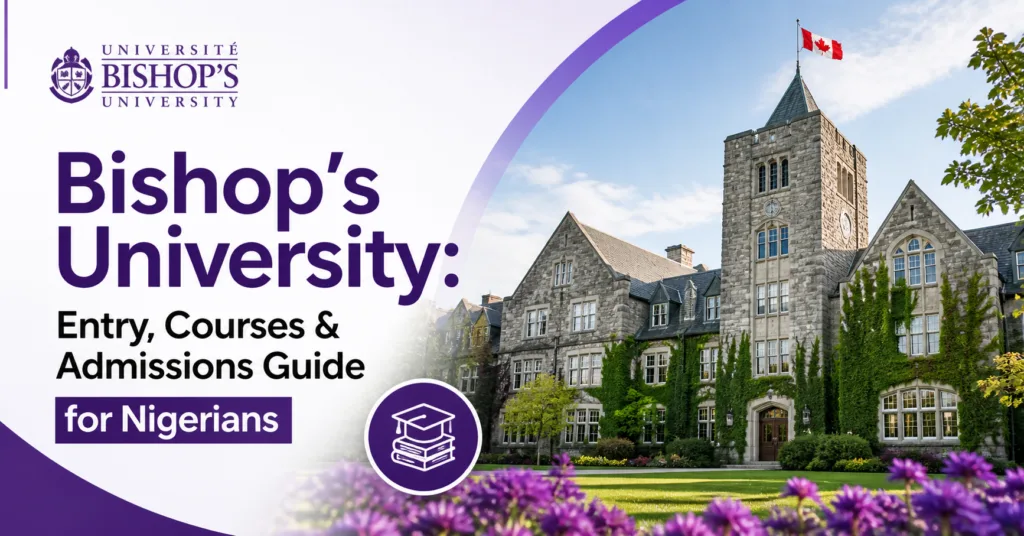
Bishop’s University is a small, English-language liberal arts university located in Lennoxville, a borough of Sherbrooke, in the province of Quebec, Canada. Founded in 1845, it is one of Canada’s oldest universities and carries with it a long tradition of undergraduate education rooted in the liberal arts model, where breadth of learning and close student-faculty relationships are central to the academic experience.
What Bishop’s offers that larger Canadian universities simply cannot is scale. With a student population of just under 3,000, the campus operates more like an academic community than an institution. Professors know students by name, class sizes are small, and the kind of mentorship that is difficult to access at a large research university is a standard part of life at Bishop’s.
Bishop’s University is ranked within the top 10 primarily undergraduate universities in Canada according to Maclean’s University Rankings, which is the most widely referenced ranking system for Canadian institutions in this category. In the QS World University Rankings, Bishop’s does not appear as a standalone entry, which is consistent with its size and focus as a teaching-first institution. Its reputation in Canada is distinguished, particularly for Education, Psychology, Business, and Computer Science. The university sits within Quebec’s higher education system, which has historically offered lower tuition than other Canadian provinces.
Table of Contents
Why Choose Bishop’s University?
University Experience
Bishop’s is often described as a boutique university, and that label captures something real. You are not a student number in a lecture hall of 400 people. The small campus means you interact regularly with professors, build lasting academic relationships, and develop the kind of professional references that carry weight when you apply for jobs or graduate school.
English-Language Education in a French Province
Quebec is primarily a French-speaking province, but Bishop’s operates entirely in English. This gives you the advantages of living in a bilingual country and province, including exposure to French and the career benefits that come with it, without being overwhelmed if French is not your strong suit on arrival. Over time, many Bishop’s students pick up functional French, which adds value to a Canadian resume.
A Campus That Feels Like Home
The Sherbrooke campus is residential and tight-knit. The majority of students live on or near campus, which creates a social environment that Nigerian students tend to find welcoming and easy to settle into. The university has an active international student community and support services designed to help new arrivals transition smoothly.
What a Bishop’s Degree Opens Up
- Eligibility for the Canadian Post-Graduation Work Permit (PGWP) after completing your programme.
- Pathways into Canadian permanent residency through Express Entry and the Quebec Experience Programme.
- A recognised Canadian degree respected by employers across North America and internationally.
- Alumni networks in education, business, and the sciences.
- Foundation for further graduate or professional study at top Canadian and international universities.
Fields of Study at Bishop’s University
Bishop’s academic structure is divided into five main areas. Most programmes are at the undergraduate level, reflecting the university’s identity as a primarily undergraduate institution.
Williams School of Business
The Williams School of Business offers the Bachelor of Business Administration (BBA) with specialisations in Accounting, Finance, Global Management, Marketing, and Entrepreneurship. It is one of the most popular entry points for Nigerian students given its career-focused curriculum and strong placement outcomes.
Humanities
The Humanities division covers English Literature, History, Liberal Arts, Modern Languages, and Philosophy. These programmes are well suited for students interested in law, communications, public service, or postgraduate study in the arts and social sciences.
Social Sciences
Psychology is the standout programme in this division and one of the most enrolled degrees at Bishop’s overall. The division also includes Economics, Politics and International Studies, and Sociology. For Nigerian students interested in development work, policy, or postgraduate study in social research, this is a good foundation.
Natural Sciences and Mathematics
This division covers Computer Science (available at both BSc and MSc level), Biology, Chemistry, Physics, and Mathematics. Computer Science in particular has good employment outcomes given the demand for tech talent across the Canadian job market.
School of Education
The School of Education offers the Bachelor of Education (B.Ed) for undergraduate students and the Master of Education (M.Ed) at the postgraduate level. These are professional degrees designed for those pursuing careers in teaching and educational administration.
Postgraduate Programmes
Bishop’s postgraduate offering is deliberately small and focused. Current graduate programmes include the Master of Education (M.Ed, course-based), the MSc in Computer Science (thesis-based), and the MSc in Physics (thesis-based). The university’s primary identity remains undergraduate, so students looking for a broad range of master’s programmes should weigh this carefully.
Tuition Fees, Deposits & Scholarships
Undergraduate Tuition
Tuition at Bishop’s is billed per credit. A standard undergraduate year consists of 30 credits. For the 2025/2026 academic year, students in Arts, Social Sciences, and Business programmes pay approximately $25,115 CAD per year. Students in Science, Computer Science, and Fine Arts pay approximately $27,587 CAD per year.
In addition to tuition, you must budget an extra $1,634 CAD per year for compulsory fees covering student services, health insurance, and administrative costs. This is mandatory and applies to all students regardless of programme.
Postgraduate Tuition
Postgraduate fees at Bishop’s are structured differently from the per-credit undergraduate model. A course-based Master’s programme such as the M.Ed costs approximately $32,631 CAD for the full programme. A thesis-based Master’s such as the MSc in Physics costs approximately $23,527 CAD in total, making the research route notably more affordable than the coursework route.
Application Fee
There is a non-refundable application fee of $75 CAD payable at the time of submission. This applies to all applicants regardless of level or programme.
Scholarships for Nigerian Students
One of Bishop’s most student-friendly policies is that Nigerian applicants are automatically considered for entrance scholarships during the admissions process. There is no separate scholarship application required at the point of entry.
Entrance scholarships range from $1,000 to $20,000 CAD and are awarded on academic merit, calculated from your WAEC/NECO results for undergraduate applicants or your university GPA for postgraduate applicants. The stronger your academic record, the higher the scholarship you are considered for. After your first year at Bishop’s, you become eligible to apply for additional Awards and Bursaries based on your academic performance on campus, creating a second opportunity to reduce your costs.
Application Requirements
Undergraduate Admissions
Academic Requirements:
- Minimum of 5 credits in WAEC or NECO, including English Language and Mathematics
- Bishop’s looks for a minimum average of B or C4 to C6 across your core subjects
- Business programme applicants must have WAEC-level Mathematics at the required grade
- Science programme applicants must present WAEC-level Mathematics plus at least two science subjects from Biology, Chemistry, or Physics
English Proficiency:
- A C6 or above in WAEC or NECO English can be used to request a waiver for the IELTS or TOEFL
- If a formal test is needed, the standard score is IELTS 6.5 or TOEFL 90
- Contact the admissions office to confirm the waiver process and what supporting documentation is needed
Documents to Prepare:
- Completed Bishop’s online application form
- WAEC or NECO result slips and certificates
- Secondary school transcripts
- Personal statement or statement of intent
- Non-refundable $75 CAD application fee
Postgraduate Admissions
Academic Requirements:
- A Bachelor’s degree from a recognised Nigerian university
- Minimum Second Class Lower (2:2) is the standard floor, though a 2:1 is preferred for competitive programmes like the MSc in Computer Science
- Official university transcripts
- A current CV or resume
- Two letters of recommendation from academic or professional referees
- A statement of research interest (for thesis-based programmes)
Admissions Timeline
Bishop’s operates on a rolling admissions basis, meaning decisions are issued as applications are reviewed instead of in one batch at the end of a cycle. For Nigerian students, this makes early application especially important because earlier submission gives you more time to process your study permit and make travel arrangements.
The Fall intake (September start) has a recommended application deadline of March 1st for Nigerian applicants. The Winter intake (January start) has a deadline of October 1st. These deadlines are specifically recommended for international applicants to allow enough time for document processing and Canadian immigration procedures.
Canadian Study Permit
Because Bishop’s is in Canada, you apply for a Canadian Study Permit. Nigerian applicants apply through Immigration, Refugees and Citizenship Canada (IRCC).
Documents required:
- Valid Nigerian passport
- Official letter of acceptance from Bishop’s University
- Proof of sufficient funds to cover tuition and living expenses
- Bank statements, proof of scholarship awards, or financial sponsorship letters
- Statement of purpose explaining your study plans and intention to return to Nigeria or pursue Canadian residency through lawful channels
- Academic transcripts and certificates
Proof of Funds: You must demonstrate through bank statements and financial documents that you have enough money to cover your first year of tuition plus living expenses. A general guideline is to show access to at least $20,000 to $25,000 CAD beyond your tuition for living costs, though the IRCC will assess this based on your full financial picture.
Cost of Living in Sherbrooke
Sherbrooke is one of the most affordable cities in Canada for students. Compared to Toronto, Vancouver, or even Montreal, the cost of living here is significantly lower, and this is one of the practical advantages of choosing Bishop’s over larger urban universities.
Accommodation (on-campus residence or off-campus shared housing): $600 – $950 CAD per month
On-campus residences at Bishop’s are a popular option for first-year international students given the convenience and the social environment they create. Off-campus shared housing is available at competitive rates in the Sherbrooke area.
Food and Groceries: $250 – $400 CAD per month
Sherbrooke has a full range of supermarkets and the university campus has dining hall options that can reduce food preparation costs.
Public Transport: $60 – $90 CAD per month
Sherbrooke has a municipal bus network and the compact size of the city means many students cycle or walk between campus and residential areas.
Health Insurance: Included in compulsory fees for most students.
The annual compulsory fee covers basic health insurance. Confirm exactly what is covered and consider supplementary private insurance depending on your health needs.
Books and Supplies: $100 – $200 CAD per month in heavy semesters
Personal and Miscellaneous: $150 – $250 CAD per month
Estimated Monthly Total: $1,160 – $1,890 CAD
Sherbrooke’s affordability relative to other Canadian cities is a financial advantage. Students who manage their budget well and take advantage of on-campus resources find the cost of living here very manageable on a student budget.
Work and Study Opportunities
Your Legal Work Rights in Canada
As an international student at Bishop’s University, your Canadian Study Permit allows you to work up to 24 hours per week off-campus during term time and full-time during scheduled breaks such as summer and winter holidays. This is a significant allowance and one of the most generous among English-speaking study destinations.
Working on Campus
Bishop’s small campus creates accessible on-campus employment opportunities including:
- Research assistant positions with faculty members
- Library and student services roles
- Residence advisor positions after your first year
- Campus event and administrative support roles
Working in Sherbrooke
Sherbrooke is a mid-sized Quebec city with a service sector and a growing technology industry. English-speaking Bishop’s students find work in:
- Retail and hospitality across the city
- Tutoring and language support services given the bilingual city environment
- Technology and data roles with Sherbrooke’s growing tech employer base
- Part-time administrative and customer service positions
Post-Graduation Work Permit (PGWP)
After completing your degree at Bishop’s, you are eligible for Canada’s Post-Graduation Work Permit (PGWP), which allows you to work anywhere in Canada for a period of up to three years depending on the length of your programme. This is one of the most valuable features of studying in Canada for Nigerian graduates, as it creates a direct pathway into the Canadian labour market and, subsequently, into permanent residency through programmes such as Express Entry or the Quebec Experience Programme (PEQ).
Study in Canada with StudyAbroadly
Canada’s study permit process, Bishop’s rolling admissions timeline, scholarship documentation, and proof of funds requirements are all manageable with the right help. Studyabroadly is a study abroad agency built specifically to help Nigerian students access quality education abroad without confusion or costly mistakes.
Here is what we do for you:
- University and Programme Matching: We review your academic background, career goals, and budget to identify the right programme and intake at Bishop’s or any other institution that fits your profile.
- Full Application Management: We handle your application from start to finish, including your personal statement, document organisation, and submission coordination.
- Scholarship Optimisation: We identify every scholarship and bursary you qualify for and make sure your application is positioned to access the maximum available award.
- IELTS Waiver and English Proficiency Guidance: We help you obtain the right documents from your Nigerian institution to support a formal waiver request.
- Proof of Funds Preparation: We guide you on structuring your financial documentation to meet Canadian immigration standards.
- Study Permit Application Support: We prepare your full study permit document pack and walk you through the process.
- Pre-Departure Orientation: We prepare you for life in Quebec, including banking, health insurance, transport, weather preparation, and what to expect in your first weeks.
- Post-Arrival Support: Our relationship does not end when you board your flight. We check in after arrival to make sure your transition into Bishop’s and into Canadian life goes well.
If Bishop’s University is where you want to build your future, reach out to Studyabroadly today. We have done this before and we will do it for you.
Frequently Asked Questions
Can I get into Bishop’s with just my WAEC result?
Yes. Five credits in WAEC or NECO, including English and Mathematics, meet the standard academic requirement for undergraduate admission. Bishop’s assesses applications holistically, so your overall grade profile across core subjects also matters.
Do I need IELTS to apply?
Not automatically. If you have a C6 or above in WAEC or NECO English, you can request a waiver. Contact the Bishop’s admissions office directly with your result to initiate this process. If a test is required, the standard score is IELTS 6.5 or TOEFL 90.
Is Bishop’s degree recognised for employment in Nigeria after graduation?
Canadian university degrees are internationally recognised. A Bishop’s degree is accepted by employers and institutions that recognise Canadian qualifications, which includes most multinational companies, professional bodies, and graduate admissions offices globally.
How does the rolling admissions process work?
Bishop’s reviews and makes decisions on applications as they arrive instead of waiting until a fixed deadline to process everyone together. This means applying early gives you a faster decision, which in turn gives you more time to sort your study permit and travel arrangements. Do not wait until the deadline, especially for the Fall intake.
What is the Post-Graduation Work Permit and how long does it last?
The PGWP is a Canadian work authorisation issued to international graduates of eligible Canadian institutions. At Bishop’s, the length of the permit is tied to the length of your programme. A four-year undergraduate degree can earn you up to three years of post-graduation work rights in Canada, during which you can live and work anywhere in the country.
Can I transition from the PGWP to permanent residency?
Yes. Canada’s Express Entry system and Quebec’s own PEQ programme both offer pathways from student to permanent resident. Nigerian graduates with Canadian work experience accumulated on the PGWP are well positioned to apply.