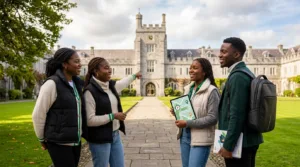
The University of East Anglia (UEA) in Norwich offers a prestigious seat at one of the UK’s top research-intensive institutions without the financial strain of London-level living costs. This modern campus university sits on 320 acres of parkland just outside Norwich city center, offering Nigerian students a blend of academic excellence, tight-knit community, and affordability that larger cities can’t match.
UEA consistently ranks among the top 30 UK universities and holds a reputation for producing graduates who make impact in their fields. With over 17,000 students from more than 100 countries and a dedicated support system for West African students, this institution has built a track record of helping Nigerian students succeed in British higher education.
Table of Contents
About University of East Anglia
The University of East Anglia opened in 1963 as part of the expansion of higher education in the UK. Notwithstanding its younger status compared to ancient universities, UEA has firmly established itself as a powerhouse in research and teaching quality.
QS World University Rankings 2026: UEA ranks 381 globally.
The university particularly excels in:
- Development Studies.
- Environmental Sciences.
- Creative Writing (launched the UK’s first Creative Writing MA program).
- Pharmacy and Pharmacology.
- International Relations.
UEA has produced Nobel Prize winners, Booker Prize-winning authors, and leading researchers whose work shapes global policy on climate change, international development, and health sciences. When you study at UEA, you’re learning from academics who advise governments and international organizations.
Why Choose University of East Anglia?
Campus and Facilities
UEA operates from a single, purpose-built campus designed by renowned architect Denys Lasdun. Everything you need sits within walking distance:
Academic Buildings:
- Ziggurat-style teaching blocks housing all academic schools.
- Sainsbury Centre for Visual Arts (world-class museum on campus).
- Library open 24/7 during term time with over 1 million books and extensive online resources.
- State-of-the-art science labs for Pharmacy, Medicine, and Environmental Sciences.
- Bloomberg Financial Markets Lab for Business students.
Student Facilities:
- Students’ Union (one of the most active in the UK) with bars, cafes, shops, and venues.
- Sportspark with Olympic-sized swimming pool, climbing wall, gym, and sports halls.
- On-campus medical center and pharmacy.
- Prayer rooms for all faiths.
- Lakeside setting with walking paths around the university’s own broad (a lake formed by peat excavation).
Accommodation: All first-year international students are guaranteed on-campus accommodation if they apply by the deadline. Living on campus means:
- 5 to 10-minute walk to all lectures and facilities.
- Built-in social life with flatmates from around the world.
- No commuting costs or time wasted on buses.
- All-inclusive bills (internet, water, heating, electricity included in rent).
Norwich: England’s Hidden Gem
Norwich is a UNESCO City of Literature and one of England’s most complete medieval cities. The city offers everything you need without the chaos and expense of London or Manchester.
City Advantages:
- Population of 200,000 (large enough for amenities, small enough to feel safe).
- Medieval castle and cathedral alongside modern shopping centers.
- 15 to 20-minute bus ride from campus to city center.
- Direct train to London in 1 hour 50 minutes.
- Norwich Airport with flights across Europe.
Cost of Living: Norwich consistently ranks as one of the UK’s most affordable cities. Your student budget stretches further here than in most other university cities.
Safety: Norwich regularly appears in top 10 lists for UK’s safest cities. Low crime rates, well-lit streets, and visible community policing make it comfortable for international students.
Cultural Scene:
- Norwich Theatre Royal and Playhouse for drama and performance.
- Norwich Arts Centre for music and exhibitions.
- Annual Norfolk and Norwich Festival (one of England’s oldest arts festivals).
- Diverse restaurant scene including Nigerian, Ghanaian, Indian, Chinese, Italian.
Research Excellence
UEA punches above its weight in research impact. The university’s Climatic Research Unit produces climate data used by governments worldwide. The School of International Development advises the UN, World Bank, and African Union on policy.
As a student, you benefit from this research culture through:
- Access to cutting-edge facilities and databases.
- Opportunities to work as research assistants on live projects.
- Teaching from academics who are leaders in their fields.
- Dissertation supervision by experts published in top journals.
Career Support
Careers Service: The university’s careers team provides:
- One-to-one career coaching.
- CV and cover letter reviews for UK job market.
- Interview preparation and mock interviews.
- Job fairs with employers specifically recruiting UEA students.
- Alumni mentoring program connecting you with graduates in your field.
- Support with Graduate Route visa applications.
Work Placements: Many courses include optional or mandatory work placements:
- Business students can do placements with local and national companies.
- Environmental Science students work with conservation organizations.
- Computing students intern with tech firms.
- Media students gain experience with BBC East and local production companies.
Graduate Outcomes: Over 95% of UEA graduates are in work or further study within 15 months of graduation, one of the highest rates in the UK.
Academic Entry Requirements
Undergraduate Entry
Academic Qualifications:
Direct Entry (Year 1):
- WAEC/NECO with five credits at C6 or above, including English and Mathematics.
- Some competitive courses (Medicine, Pharmacy) need higher grades and additional entrance tests.
Advanced Entry:
- HND with Upper Credit or Distinction may qualify for Year 2 entry in some courses.
- Depends on how your HND content matches the degree curriculum.
Foundation Programs: If you don’t meet direct entry requirements, INTO UEA International Study Centre offers:
- International Foundation Year (prepares for undergraduate entry).
- International Year One (equivalent to first year of degree, progresses to Year 2).
English Language Requirements:
UEA accepts WAEC/NECO English Language C6 or higher (within 10 years) as proof of English proficiency for most courses.
If your WAEC/NECO doesn’t qualify:
- IELTS Academic: 6.0 overall (minimum 5.5 in each component).
- TOEFL iBT: 79 overall.
- PTE Academic: 58 overall.
Medicine and some humanities courses need IELTS 7.0 or 7.5.
Documents Required:
- Academic certificates and transcripts.
- Personal statement.
- Academic reference.
- Passport bio-data page.
- English language proof (unless waived).
Postgraduate Entry
Academic Qualifications:
For Taught Masters:
- Second Class Lower (2:2) from recognized Nigerian university is minimum requirement for most programs.
- Competitive courses prefer Second Class Upper (2:1) or First Class.
- HND with Upper Credit or Distinction plus work experience may be considered.
For PhD:
- Masters degree usually needed.
- Research proposal (2,000 to 3,000 words).
- Evidence of research capability.
English Language Requirements:
WAEC/NECO C6 in English (within 10 years) waives IELTS for most programs.
Otherwise:
- IELTS Academic: 6.5 overall (minimum 6.0 in each component).
- TOEFL iBT: 88 overall.
- PTE Academic: 61 overall.
Some courses (International Development, Education) need IELTS 7.0.
Documents Required:
- All degree certificates and transcripts.
- Two references (academic preferred).
- Personal statement or research proposal.
- CV/Resume.
- Passport bio-data page.
- English proficiency proof (unless waived).
Tuition Fees and Deposits
Undergraduate Tuition (2026/2027 Entry)
Classroom-Based Courses: £18,000 to £20,000 per year.
- Business, Economics, Law, Social Sciences, Humanities.
Laboratory-Based Courses: £23,000 to £26,000 per year.
- Environmental Sciences, Pharmacy, Medicine, Biological Sciences.
Medicine (MBBS): £30,000 to £40,000 per year (varies by year of study).
Postgraduate Tuition (2026/2027 Entry)
Taught Masters: £18,000 to £22,000 per year.
- Most arts and social sciences: £18,000 to £19,500.
- Sciences and lab-based: £20,000 to £22,000.
MBA: £24,000 per year.
PhD: £18,000 to £22,000 per year (3 to 4 years).
Tuition Deposit
UEA requires a deposit to confirm your place. The deposit deducts from your first-year tuition.
Remaining balance can be paid in installments throughout the academic year.
Scholarships for Nigerian Students
UEA Nigeria Award
Value: £5,500 to £6,500 tuition reduction.
Eligibility:
- Automatic award for Nigerian postgraduate students.
- Must meet academic entry requirements.
- No separate application needed.
This scholarship applies directly to your tuition fees, reducing your annual cost significantly.
International Undergraduate Merit Scholarship
Value: £5,000 per year (renewable for duration of course).
Eligibility:
- High-achieving Nigerian students applying for undergraduate programs.
- Based on academic results.
- Automatic consideration when you apply.
International Development Scholarships
Value: Full tuition or partial awards up to £10,000.
Eligibility:
- Students applying to School of International Development programs.
- Based on academic merit and personal statement.
- Competitive application process.
- Preference given to students from developing countries planning to return home after graduation.
Regional Scholarships
UEA occasionally offers West Africa-specific scholarships. These depend on partnerships and available funding. Check the scholarships page or contact the West Africa team for current opportunities.
External Scholarships
Nigerian students can also pursue:
- Commonwealth Scholarships (for development-related courses).
- Chevening Scholarships (competitive, full funding).
- Employer or organizational sponsorship.

Visa Requirements and Proof of Funds
Student Visa Process
After receiving your unconditional offer and paying your deposit, UEA issues your CAS. Use this to apply for your Student visa at VFS Global.
Visa Requirements:
- Valid passport (minimum 6 months validity).
- CAS letter from University of East Anglia.
- Proof of funds.
- TB test certificate from approved clinic.
- Academic qualifications.
- Visa application fee.
- Immigration Health Surcharge.
Processing Time: 3 to 6 weeks from submission.
Proof of Funds
Norwich is outside London for visa purposes.
Calculation:
- £1,171 per month for 9 months which sums up to £10,539 living costs.
- Plus first year tuition minus deposit already paid.
Example:
- First year tuition: £19,000.
- Deposit paid: £3,500.
- Living costs: £10,539.
- Total POF needed: £26,039.
Funds must sit in your account (or sponsor’s account with consent letter) for 28 consecutive days before visa application.
Accepted Evidence:
- Bank statements covering 28 days.
- Education loan letter.
- Scholarship letter confirming funding.
Cost of Living in Norwich
Accommodation
University Halls:
- Standard room (shared bathroom): £110 to £140 per week.
- En-suite room: £140 to £170 per week.
- Studio apartment: £180 to £210 per week.
University accommodation includes all bills (internet, water, heating, electricity, contents insurance). Contracts last 38 to 40 weeks (academic year).
Private Accommodation:
- Shared house: £350 to £500 per month per person.
- One-bedroom flat: £600 to £800 per month.
- Two-bedroom flat: £850 to £1,100 per month.
Private rentals need deposits and separate utility setup.
Food and Groceries
Monthly Food Budget:
- Budget: £150 to £220.
- Moderate: £250 to £350.
- Comfortable: £380 to £480.
Where to Shop:
- Aldi and Lidl: Cheapest options.
- Tesco, Sainsbury’s, Asda: Mid-range with variety.
- Norwich Market: Outdoor market with fresh produce, international foods.
- International shops: African and Asian groceries including yam, plantain, palm oil, Maggi, garri.
Eating Out:
- Campus food outlets: £3 to £6.
- Fast food: £5 to £8.
- Restaurant meal: £10 to £18.
- African restaurants in Norwich: £8 to £15.
Transportation
Walking and Cycling: Campus is self-contained, so most students walk everywhere. Norwich is flat and cycle-friendly. Second-hand bikes cost £60 to £130.
Other Monthly Costs
- Mobile phone: £10 to £25.
- Internet (if not included): £25 to £35.
- Gym: £25 to £40.
- Laundry: £15 to £20.
- Personal care: £20 to £35.
- Entertainment: £50 to £100.
Total Monthly Budget
Conservative estimate: £900 to £1,100.
Comfortable estimate: £1,200 to £1,500.
Norwich’s affordability means your money goes further than in most UK cities.
Money-Saving Tips
- Live on campus first year (all-inclusive bills simplify budgeting).
- Shop at Aldi and Lidl for groceries.
- Cook in bulk and freeze meals.
- Use student discount cards and apps.
- Walk or cycle instead of taking buses.
- Take advantage of free campus events and societies.
- Buy second-hand textbooks or use library resources.
Work-Study Opportunities
During Term Time
International students can work up to 20 hours per week during term.
On-Campus Jobs:
- Student ambassador.
- Library assistant.
- Students’ Union staff (bars, shops, venues).
- IT support.
- Research assistant.
- Sportspark staff.
The university posts these jobs through the careers portal, and they’re flexible around your timetable.
Off-Campus Jobs:
- Retail in Norwich city center.
- Hospitality (restaurants, hotels, pubs).
- Care work.
- Tutoring.
Norwich’s lower cost of living means even part-time earnings cover more of your expenses than in expensive cities.
During Holidays
Work full-time (up to 40 hours per week) during Christmas, Easter, and summer breaks.
Summer work in Norwich’s tourism and hospitality sector is readily available from May to September.
Work After Graduation
Graduate Route Visa:
- 2 years for undergraduates and taught masters.
- 3 years for PhD graduates.
- Work anywhere in the UK without employer sponsorship.
Campus Life at UEA
UEA Nigerian Students’ Society
The Nigerian Society at UEA is one of the most active cultural groups on campus. With members across all academic schools, the society creates a community for Nigerian students.
Society Activities:
- Welcome events during Freshers’ Week.
- Independence Day celebrations (October 1st) with traditional food, music, and cultural displays.
- Christmas and Easter parties.
- Study groups and exam preparation sessions.
- Career networking with Nigerian alumni working in UK and Nigeria.
- Housing advice for students moving off-campus.
- Mentoring program pairing new students with experienced members.
African-Caribbean Society (ACS)
For broader African diaspora connection, ACS brings together students from across Africa and the Caribbean for:
- Cultural showcases and talent shows.
- Afrobeats nights and parties.
- Black History Month events.
- Collaboration with other cultural societies.
Nigerian Community in Norwich
Norwich has an established Nigerian community beyond the university:
Churches:
- Nigerian churches.
- Catholic churches.
- Various denominations with African fellowship groups.
Food and Groceries:
- International shops selling yam, plantain, palm oil, garri, ogbono, egusi, Maggi cubes.
- African restaurants serving jollof rice, pounded yam, egusi soup, pepper soup.
- Norwich Market stalls with African and Caribbean produce.
Hair and Beauty:
- African hair salons for braiding, weaving, cornrows.
- Barbershops specializing in African hair.
Student Life Beyond Academics
UEA Students’ Union: One of the UK’s most active students’ unions with:
- Over 200 societies covering every interest.
- Sports clubs for 40+ different sports.
- Live music venue hosting major artists.
- Bars, cafes, and social spaces.
- Student-run radio station and magazine.
Faith and Spirituality:
- Multi-faith chaplaincy supporting all religions.
- Active Christian Union.
- Islamic Society with prayer facilities.
- Various faith groups and fellowships.
Sports and Recreation:
- Sportspark with Olympic pool, climbing wall, gym.
- Extensive playing fields for football, rugby, cricket.
- Free fitness classes for students.
- Lakeside walks and outdoor spaces.
Cultural Attractions:
- Sainsbury Centre (free entry, world-class art collection).
- Norwich Castle Museum and Art Gallery.
- Norwich Cathedral (800+ years old).
- Theatre Royal and Playhouse.
- Cinema on campus and in city center.
StudyAbroadly: Best UK Study Abroad Consultant in Nigeria
StudyAbroadly is Nigeria’s leading education consultancy and a trusted bridge between ambitious students and top tier UK institutions. Our team provides a strategic partnership for those managing the complexities of UK admissions. We maintain direct relationships with admissions teams at the University of East Anglia to ensure your application stands out.
Every step of your journey is managed with precision to simplify the process and maximize financial aid. You can rely on our expertise to handle the heavy lifting of your visa journey and ensure a seamless transition to your new campus. Your goal is a world class degree and our mission is to make that reality accessible and stress free.
How We Help Applicants
Strategic Course Selection: Many students apply to wrong courses for their background or career goals. We prevent this by:
- Analyzing your academic history and career ambitions.
- Identifying UEA programs that match your profile.
- Explaining which courses lead to specific career paths.
- Advising on courses with best scholarship opportunities.
- Helping you understand entry requirements realistically.
Application Excellence: Your application competes with thousands of others. We maximize your chances by:
- Making sure personal statements highlight your strengths.
- Structuring your application to meet UK academic standards.
- Ensuring all documents are formatted correctly and translated if needed.
- Submitting applications early to improve scholarship chances.
- Tracking your application and communicating with UEA on your behalf.
Scholarship Maximization: Most students miss out on scholarships simply because they don’t know about them or apply incorrectly. We:
- Identify every scholarship you qualify for at UEA.
- Complete scholarship applications with supporting statements.
- Coordinate with UEA’s scholarship office to ensure your application is reviewed.
- Follow up on scholarship decisions and advocate for reconsideration if needed.
Visa Success: UK visa refusals devastate students who’ve already paid deposits and made plans. We prevent refusals by:
- Reviewing your financial documents before submission to ensure they meet UKVI standards.
- Completing visa forms with precision (one mistake can cause refusal).
- Coordinating your CAS issuance with UEA’s compliance team.
- Scheduling your VFS appointment at the best time.
Frequently Asked Questions
Does UEA really accept WAEC without IELTS?
Yes. If you scored C6 or higher in WAEC/NECO English Language within the last 10 years, UEA accepts this for most programs. You submit your certificate with your application, and they verify it directly.
What makes UEA different from other UK universities?
UEA combines research excellence (top 300 globally) with a campus community. Unlike city universities where students are scattered, UEA’s single campus creates good social bonds. The university also punches above its weight in specific fields like Development Studies (top 10 globally) and Environmental Sciences (top 50 globally).
Is Norwich boring compared to London or Manchester?
Norwich is quieter than major cities, which some students prefer. You get safety, affordability, and easy access to everything without urban chaos. London is less than 2 hours by train for weekend trips. Most students find Norwich offers better quality of life than expensive, crowded cities.
Can I work enough hours to support myself?
Part-time work (20 hours weekly during term) generates roughly £600 to £800 monthly, which covers most living costs in Norwich. However, you shouldn’t rely entirely on part-time work as finding employment takes time and isn’t guaranteed.
What happens if I don’t get the grades my offer requires?
Contact UEA immediately. If you miss your offer by a small margin, they may still accept you or offer an alternative course. If the gap is significant, you might need to retake exams or complete a foundation year.
Are Nigerian qualifications truly recognized at UEA?
Yes. UEA has clear equivalencies for Nigerian degrees on their website. They work closely with Nigerian universities and understand the grading system. Your degree from a recognized Nigerian institution carries full weight in admissions decisions.
How quickly can I get my CAS after paying the deposit?
UEA typically issues CAS within 2 to 3 weeks of receiving your deposit and all required documents. During peak season (June to August), allow up to 4 weeks. Apply early to avoid time pressure.
What if I need to defer my admission to next year?
Contact UEA’s admissions office with your reason for deferring. Most requests are approved if made within specified deadlines. Your deposit transfers to the next academic year, and most scholarships carry over (confirm this when you defer).
Is there really a Nigerian community in Norwich?
Yes. The Nigerian Society has been active for decades and now has hundreds of members. Beyond campus, Norwich has Nigerian churches, restaurants, and shops. You’ll find community easily.
How cold does Norwich get in winter?
Winter temperatures in Norwich sit between 2°C and 7°C (December to February). You need warm clothing, but it’s not extreme. The university buildings are well-heated. Summer is mild at 15°C to 20°C. Rain is frequent year-round, so invest in good waterproof jacket.
Can I change my course after I arrive?
Yes, within the first few weeks of term if you have valid reasons and the new course has space. You need approval from both academic schools and must consult the International Office as it affects your visa status.
What if my visa gets refused?
Refusals are rare if applications are prepared correctly. If refusal happens, you can:
- Request detailed refusal reasons.
- Reapply with corrected issues.
- Appeal if the refusal was incorrect. We guide you through whichever route is appropriate and work with UEA to protect your place.
Do I really need to use a consultancy or can I apply myself?
Consultancies such as StudyAbroadly provide value through:
- Knowledge of what admissions teams actually want to see.
- Experience preventing common mistakes that cause rejections.
- Scholarship identification and application support.
- Visa expertise that reduces refusal risk.
- Time savings (we handle paperwork while you focus on exams or work). Most students find the support worthwhile, especially for first UK application.
Will my dependants be able to find work in Norwich?
Norwich has lower unemployment than many UK cities. There are pportunities in retail, hospitality, healthcare, education, and administration. Many Nigerian spouses find work within a few months of arrival. The university’s careers service helps dependants too.
How do I prove my WAEC result is genuine?
UEA may request your scratch card or verification token to confirm results directly with WAEC. Keep these safe.
What makes INTO UEA different from direct entry?
INTO UEA runs pathway programs (foundation year and international year one) for students who don’t meet direct entry requirements. These programs are designed specifically for international students, with extra English support and smaller class sizes. Successful completion guarantees progression to UEA degree programs.
Can I visit home during the academic year?
Only during official holidays (Christmas, Easter, reading weeks). UK immigration monitors attendance, and missing classes for personal travel can affect your visa status. Plan family visits during scheduled breaks.
The University of East Anglia gives Nigerian students access to world-class education in a safe, affordable, and welcoming environment.