Dreaming of a career in the heart of Europe’s tech and finance capital? National College of Ireland (NCI) offers world-class undergraduate, postgraduate, and higher diploma programs designed specifically for the modern workforce. Located in Dublin’s bustling IFSC, NCI combines a rich 70-year history with a forward-thinking approach to learning. With over 25% of the student body coming from abroad, you’ll find a diverse, welcoming environment that prioritises your future employability and success in Ireland.
Table of Contents
About National College of Ireland (NCI)
Located in the heart of Dublin’s Silicon Docks, the National College of Ireland (NCI) is a state-supported institution known for its industry-aligned education system. Founded in 1951 as a Jesuit institution, NCI has evolved into a dynamic hub for Business, Computing, and Psychology, boasting a 4 QS stars overall with 5-star ratings in Employability, Facilities, Social Responsibility, and Inclusiveness. It ranks within the top 200 in Europe for employability (QS Regional 2024) and the top 500 globally for Industry Partnerships.
Quick Facts
- Location – Mayor Square & Spencer Dock, Dublin
- Global Ranking – #15 in Ireland (QS Star Rating)
- Key Schools – Business, Computing, Psychology, Education
- Employability – 96% of graduates employed or in further study
Why Choose National College of Ireland (NCI)?
Choosing NCI is a strategic career move. Located in the heart of Dublin, NCI offers a unique mixture of historical academic prestige and an ultra-modern, industry-led curriculum.
For Nigerian students, NCI is a gateway to the European job market, combining affordable tuition with a high-energy city lifestyle. Here is why NCI stands out in 2026:
Campus and Facilities: A “Campus Without Walls”
NCI’s campus is designed for the modern professional. Rather than an isolated system, the campus is integrated into the city’s financial hub.
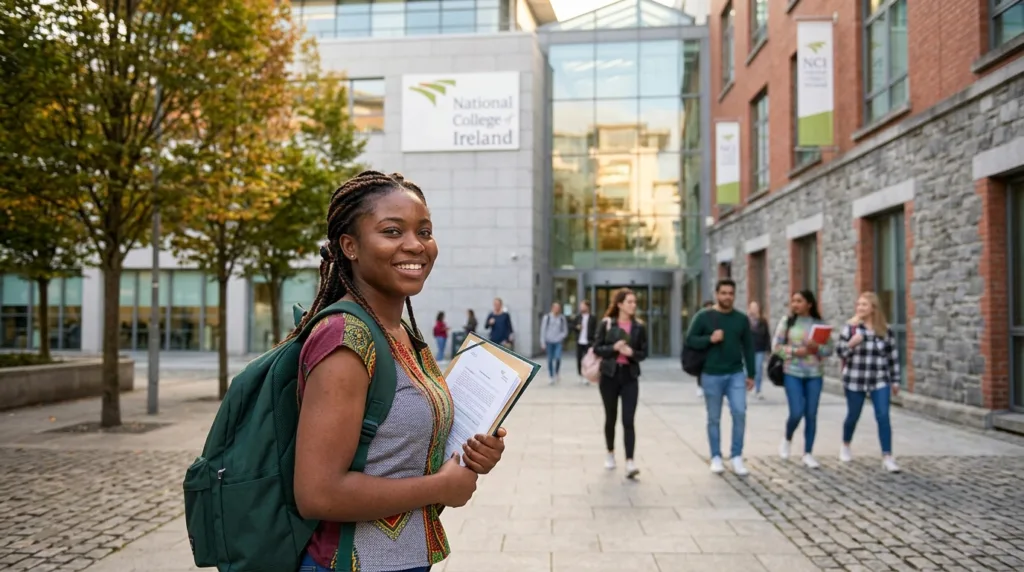
- Modern Infrastructure: Based at Mayor Square and Spencer Dock, the campus features tiered lecture theatres, high-tech computing labs, and a spacious atrium designed for networking.
- A Compact, Safe Environment: The two main buildings are just a 3-minute walk apart, ensuring you never waste time commuting between classes.
- Extensive Sports Access: While NCI is city-based, students have access to first-class off-site facilities, including the SV Fitness Club and Irishtown Stadium for football, basketball, and tennis.
City Advantages: The Heart of the IFSC
NCI is located in the International Financial Services Centre (IFSC), often referred to as the “Silicon Docks.”
- The Hub of Giants: You are literally neighbours with the European headquarters of Google, Meta, TikTok, and JP Morgan. This proximity makes attending industry meetings and networking opportunities as easy as crossing the street.
- Seamless Transport: The Luas (Dublin’s light rail) stops directly at the campus gates (Mayor Square station), connecting you to the rest of the city and suburban residential areas in minutes.
Cultural Scene: A Home for Nigerians in Dublin
For Nigerian students, the transition is easy because of the thriving local community of Nigerians in Dublin.
- The Nigerian Diaspora: Dublin has a well-established Nigerian population. You will find African grocery stores (selling ingredients for local Nigerian foods) within a short distance of the city centre.
- Faith and Community: There are numerous active Nigerian-led church congregations and cultural associations in Dublin, ensuring you have a spiritual and social support system.
- Cultural Blend: While Dublin has a more relaxed “pace of life” compared to the high energy of Lagos, the city’s pubs, live music, and football culture resonate well with the Nigerian love for social connection.
Career Support: The 96% Success Rate
NCI is famous for its Career Development & Employability Team, which has helped the college maintain a consistent 96% graduate placement rate.
- One-on-One Coaching: As a student, you will get personalised CV workshops, mock interview sessions, and LinkedIn profile optimisation.
- Direct Access to Recruiters: Because of NCI’s reputation, top-tier companies regularly visit the campus specifically to recruit from the Business and Computing schools.
Work Placements: Real-World Experience
Unlike traditional academic degrees, many NCI programs require you to work.
- Undergraduate Placements: Most Business and Computing degrees include a 6 to 12-month accredited work placement.
- Postgraduate Projects: Master’s students often engage in 12-week placements or industry-sponsored capstone projects, which often lead to full-time job opportunities before graduation.
Financial Value & Scholarships
NCI remains one of the most cost-effective, high-quality options in Ireland.
- Competitive Tuition: Undergraduate fees average €12,000–€14,000, significantly lower than major universities in the UK or USA.
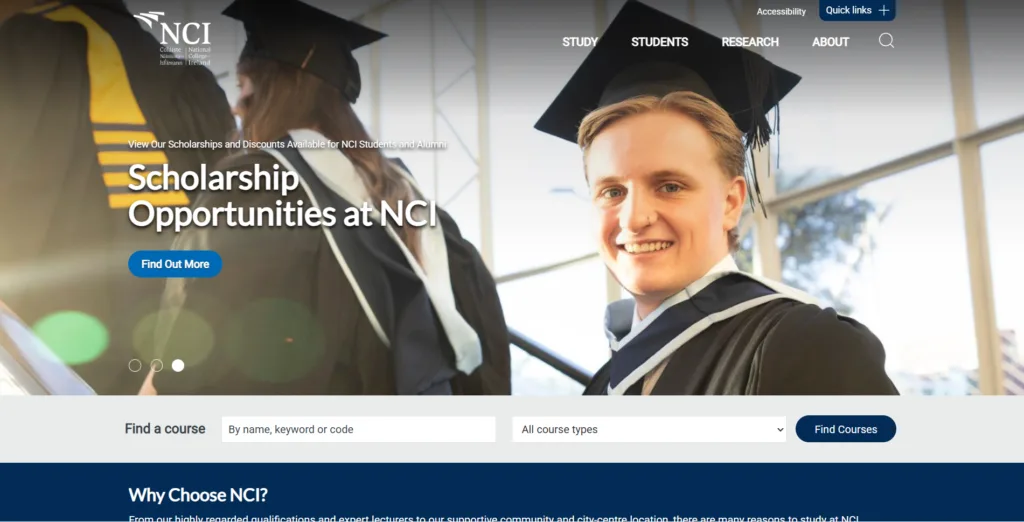
- Automatic Scholarships: NCI offers merit-based scholarships for international students that can significantly reduce the cost of tuition for those with strong academic backgrounds.
Academic Entry Requirements for Nigerians
To secure admission at NCI in 2026, you must meet specific academic and English language benchmarks. As a Nigerian applicant, your West African Senior School Certificate (WAEC/NECO) and previous university degrees are the primary documents for assessment based on the study type you are going for.
Here is a breakdown of the requirements for each level of study:
1. Bachelor’s Degree (Undergraduate)
NCI typically looks for students who have completed a full secondary education with strong results in core subjects.
- WAEC/NECO Requirements: A minimum of 5 credits (including Mathematics and English).
- Grade Benchmark: An overall average of 70% or higher in your final year subjects is expected for direct entry.
- Alternative Pathways:
- Foundation Programme: If you have the SSCE but do not meet the direct entry grades, you can enrol in a recognised Foundation year (requiring 60%–65% in WAEC).
- Diploma Entry: If you hold an Ordinary National Diploma (OND) with Upper Credit or Distinction, you may be eligible for Year 1 entry.
- Advanced Entry: Applicants with a Higher National Diploma (HND) with high grades may be considered for entry into Year 2 or Year 3 of a related Bachelor’s degree.
2. Master’s Degree (Postgraduate)
Admission to NCI’s Master’s programs is quite competitive, particularly in the School of Computing and the School of Business.
- Academic Standing: A recognised Bachelor’s degree with a minimum award of Second Class Lower (2.2) or higher.
- Specific Stream Requirements:
- Computing/Data/AI: Requires a degree in a related field like Computer Science or STEM.
- Business/Management: Many of these programs accept degrees from non-related areas (any discipline).
- Work Experience (RPEL): NCI operates a Recognition of Prior Experiential Learning scheme. If you don’t have a 2.2 degree but have 5–7 years of relevant professional experience, you may still be considered for certain Master’s programs.
3. PhD (Doctoral Research)
PhD admissions at NCI are research-based rather than taught-module-based.
- Academic Requirement: A recognised Master’s degree with high honours in a field related to your proposed research.
- Research Proposal: A comprehensive research proposal must be provided, and it must align with the expertise of NCI’s faculty (primarily in Cloud Computing, Fintech, HR, or Education).
- Supervisor Match: Admission is often based on finding a supervisor within NCI who is willing to oversee your project.
English Language Proficiency (2026 Standards)
While a high grade (C6 or better) in WAEC English is often accepted as proof of proficiency for Nigerian students, some programs or visa requirements may necessitate a formal test.
Documents Required:
- All degree certificates and transcripts.
- Two references (academic preferred).
- Personal statement or research proposal.
- CV/Resume.
- Passport bio-data page.
- English proficiency proof (unless waived).

Ready to start your study abroad journey?
Chat with our StudyAbroadly advisors for free guidiance tailoredto Nigerian students
Tuition Fees and Deposits
Studying in Dublin can be a huge investment for Nigerians. The good news is that NCI is one of the most affordable high-quality options in Ireland, especially when you factor in their automatic scholarships for African students.
1. Tuition Fee Estimates (2026 Intake)
NCI keeps it simple. Fees are generally charged per year, and for most International students, the standard price looks like this:
Programme Level | Typical Annual Fee | With Average Scholarship* |
| Bachelor’s Degree (Business/HRM) | €12,000 | €10,000 |
| Bachelor’s Degree (Computing/Data) | €15,000 | €13,000 |
| Masters Degree (MSc/MA/MBA) | €15,000 – €17,000 | €11,000 – €13,000 |
| Higher Diploma (Level 8) | €12,000 | €10,000 |
Most Nigerian students with a 2.1 (Upper Credit) automatically get €4,000 off their Master’s. If you have a 2.2, you’re still looking at €2,000–€3,000 off. No extra application is needed—they just check your result and deduct it!
2. The “Visa-Ready” Deposit
To get your Visa Support Letter (the document you need to show the Irish Embassy in Abuja or Lagos), you have to pay a minimum of €6,000.
The Reality for Nigerians: While NCI accepts a deposit, the Irish Visa Office strongly prefers to see that you’ve paid your Full First Year Tuition before you apply for your visa. It shows you’re “serious” and have the funds, which drastically reduces your chance of a visa refusal.
3. Other Important Costs
Here are some other payments you will make when you get to Dublin:
- Medical Insurance: Approx. €200 (Mandatory for your visa).
- Protection for Learners (PEL): Approx. €50 (This is a government insurance that protects your tuition if the school closes—very standard).
- Gym/Student Facilities: €80 per year.
- Ireland Resident permit (IRP) Card: €300. This can be paid to the Irish police when you arrive.
4. NCI Refund Policy
If your visa is not approved, NCI has a very fair refund policy. They will return your tuition fee, usually minus a small administrative charge (around €200), as long as you provide the official refusal letter from the embassy.
Scholarships for Nigerian Students
Most of NCI’s scholarships are automatic, meaning the admissions team does the work for you.
1. NCI Automatic Academic Scholarships
These are the most common awards. You don’t apply for them; once you submit your application for a course, NCI reviews your transcripts and applies the discount to your offer letter if you qualify.
For Master’s Students (Postgraduate)
Based on your Nigerian Bachelor’s degree classification:
- First Class Honours (1st): Up to €5,000 discount.
- Second Class Upper (2.1): Up to €4,000 discount.
- Second Class Lower (2.2): Up to €2,000 – €3,000 discount.
For Bachelor’s Students (Undergraduate)
Academic Merit Award: Between €2,000 and €3,000 per year off your tuition. If you have strong A-levels or high B’s and A’s in your WAEC/NECO, you are a prime candidate for this.
Specific Higher Diploma Discounts
Computing & Data Analytics: If you are taking a “top-up” Higher Diploma to pivot into tech, there is a standard scholarship of €4,000 often available for these specific streams.
2. The “Big Three” Prestigious Scholarships
These are not automatic and require a separate, highly competitive application process. They are perfect for students with leadership experience and high grades.
| Scholarship Name | What it Covers | Who is it for? |
| GOI-IES (Govt. of Ireland) | Full Tuition Waiver + €10,000 Stipend | Top 60 students globally. Must have an NCI offer first. |
| 30% Club Scholarship | 100% Full Tuition | For women applying to Masters in STEM (Computing) or Business. |
| Ireland Fellows Programme | Full Ride (Fees, Flights, Rent, Food) | For women applying to a Master’s in STEM (Computing) or Business. |
Cost Of Living in Dublin
Dublin is beautiful, but it’s no secret that it can be expensive if you don’t plan well. As a Nigerian student, the key is knowing what to save on so you can have enough money for the important stuff.
Here’s a breakdown of what you’ll actually spend monthly in Dublin as a student in 2026.
1. Monthly Budget Breakdown (Estimated)
| Expense Category | Monthly Cost (EUR) |
| Rent (Shared Room) | €600 – €900 |
| Groceries/Food | €250 – €350 |
| Transport (Student Leap Card) | €48 – €80 |
| Utilities (Electricity/Heating) | €60 – €100 |
| Mobile Data & Internet | €20 – €40 |
| Personal/Social Life | €100 – €200 |
| Total | €1,078 – €1,670 |
Important Note: For your Irish Student Visa (Stamp 2), you generally need to show you have access to at least €10,000 for your living expenses for the year (excluding tuition).
2. Deep Dive: Where the Money Goes
- Accommodation: Rent is your biggest bill. The Secret is that most Nigerian students share an apartment with 2 or 3 others to keep costs near €600–€700. And also, location matters a lot; areas like Dublin 1, 2, and 4 (near NCI) are premium. Looking at Dublin 7, 8, or North Dublin near the Luas line can save you €100+ a month.
- Groceries: You need to learn how to shop like a local. Shopping at high-end stores will make your money vanish in no time. The “Big Three”: Lidl, Aldi, and Tesco are your best friends. For Nigerian foods like plantain, yam, palm oil, and egusi, you should head to Moore Street or Parnell Street, where it is cheaper than the specialty African shops in the suburbs.
- Transport: The Leap Card is a lifesaver in Dublin. Never pay cash for the bus or Luas! You should apply for a Student/Young Adult Leap Card as a student. The good thing about the Leap Card is the cap, once you spend €12 in a week, the rest of your travel on Dublin Bus, Luas and DART is free for that week.
3. Survival Tips for the “Newbie”
- Winter is Coming: Heating bills spike in December–February. Budget an extra €40 for those months.
- Part-Time Work: Your visa allows you to work 20 hours/week (and 40 hours during holidays). With the 2026 minimum wage at €14.15 per hour, you can earn roughly €1,100+ a month, which covers most of your basic living costs!
- Student Discounts: From clothes at Penneys to cinema tickets and even Apple products—always ask “Is there a student discount?” It’s usually 10%–15% off.
Visa Requirements and Proof of Funds
Getting your visa is the final step of the study abroad journey. For Nigerian students, the Irish Embassy is very strict about Proof of Funds. They want to see that you have the money and, more importantly, that the money is “yours” and not just a “quick deposit” to impress them.
Here is the breakdown of the 2026 Ireland Student Visa (Stamp 2) requirements.
1. The “Big Two” Financial Pillars
To get a “Yes,” you must prove you have covered two things: your school fees and your life in Dublin.
- Tuition Payment: You must show a receipt proving you have paid at least €6,000 (or your full fee if it’s lower).
Tip for Nigerians: Paying your full tuition up front drastically increases your visa success rate. It shows you aren’t planning to drop out once you land.
- The €10,000 Rule (Living Expenses): You must prove you have at least €10,000 accessible for your first year of living costs. This money must be in your account (or your sponsor’s) for at least 6 months before you apply.
2. Proof of Funds: Essential Documents
The visa officer will check your bank statement like a detective.
- 6-Month Bank Statements: Provide original, stamped statements for the last 6 months.
- Source of Funds: If a large sum suddenly enters the account, you must explain it with documents (e.g., a land sale agreement, a gratuity payment, or a business profit). “Gift from an uncle” without proof usually leads to a refusal.
- Sponsorship (If not self-funded):
- Affidavit of Support: A legal document from your sponsor (parent/guardian) promising to pay.
- Sponsor’s Income: Pay slips, business registration (CAC documents), or tax returns to show where the money comes from.
3. Required Visa Documents Checklist
Gather these in a clear folder—no stapling, just clips!
- AVATS Summary Form: Printed and signed after your online application.
- Letter of Acceptance: From NCI, confirming your course is full-time (minimum 15 hours/week).
- Academic History: Your original WAEC/NECO/Degree certificates and transcripts.
- English Proficiency: IELTS, Duolingo, or a letter from your university if your degree was taught in English.
- Medical Insurance: Proof of a private policy (usually arranged via NCI for ~€200).
- SOP (Statement of Purpose): Explaining why you chose Ireland, why NCI, and—most importantly—why you will return to Nigeria after your stay-back visa expires.
4. Visa Fees & Logistics
| Item | Cost | Note |
| Visa Application Fee | €60 | Single entry (D-Study Visa) |
| VFS Service Fee | ~₦50,000 – ₦70,000 | Paid at the VFS center in Lagos or Abuja |
| IRP Card (Post-Arrival) | €300 | Paid at the VFS centre in Lagos or Abuja |
5. Why Visas Get Refused (Avoid These!)
- “Lump Sum” Deposits: Large amounts appearing in the bank account 2 weeks before the application.
- No Home Ties: Failing to prove you have a reason to return to Nigeria (family, business, or a career plan).
- Vague SOP: Using a generic template from the internet. The embassy wants to hear your voice.
Work-Study Opportunities
One of the biggest questions Nigerian students ask is: “Can I work as a student?” The answer is a YES, but there are rules you must abide by to keep your visa safe.
1. Part-Time Work (While You Study)
In Dublin, you don’t need another permit to get a part-time job. Your Stamp 2 visa automatically gives you the right to work “casual” hours.
- Term Time: You can work up to 20 hours per week.
- Holiday Periods: You can work up to 40 hours per week (Full-time).
- 2026 Minimum Wage: As of January 1, 2026, the national minimum wage is €14.15 per hour. So a 20-hour work week will give you roughly €1,132/month before tax. This is usually enough to cover your rent and food.
2. The “Stay-Back” Option (Stamp 1G)
This is the most important part of your NCI journey. After you graduate, Ireland wants you to stay and work in their economy. This is called the Third Level Graduate Scheme.
- Bachelors (Level 8) & Higher Diplomas: You get 12 months to stay and work full-time.
- Masters & PhD (Level 9/10): You get 24 months (2 years) to stay and work full-time.
3. Professional Work Placements (Internships)
NCI is famous for its “Industry-Focused” design. Many courses in the School of Computing and the School of Business include a formal work placement.
By law, your internship cannot take up more than 50% of your total course time. These are often paid internships. Many Nigerian students at NCI get their full-time job offers through these placements before they even finish their final exams.
4. Common Student Jobs in Dublin
- Retail: Sales assistants at Penneys, Tesco, or Zara.
- Hospitality: Servers, baristas, or kitchen assistants (very high demand).
- Tech Support: Customer service roles for multinational tech companies (perfect for Computing students).
- Care Work: Healthcare assistants (often pays higher than minimum wage).
StudyAbroadly: Best Study Abroad Consultant in Nigeria
StudyAbroadly is Nigeria’s leading education consultancy and a trusted bridge between ambitious students and top-tier institutions. Our team provides a strategic partnership for those managing the complexities of Ireland admissions. We maintain direct relationships with admissions teams at the National College of Ireland to ensure your application stands out.
Every step of your journey is managed with precision to simplify the process and maximise financial aid. You can rely on our expertise to handle the heavy lifting of your visa journey and ensure a seamless transition to your new campus. Your goal is a world-class degree, and our mission is to make that reality accessible and stress-free.
How We Help Applicants
Strategic Course Selection: Many students apply to the wrong courses for their background or career goals. We prevent this by:
- Analysing your academic history and career ambitions.
- Identifying NCI programs that match your profile.
- Explaining which courses lead to specific career paths.
- Advising on courses with the best scholarship opportunities.
- Helping you understand entry requirements realistically.
Application Excellence: Your application competes with thousands of others. We maximise your chances by:
- Making sure personal statements highlight your strengths.
- Structuring your application to meet Ireland’s academic standards.
- Ensuring all documents are formatted correctly and translated if needed.
- Submit applications early to improve scholarship chances.
- Tracking your application and communicating with NCI on your behalf.
Scholarship Maximisation: Most students miss out on scholarships simply because they don’t know about them or apply incorrectly. We:
- Identify every scholarship you qualify for at NCI.
- Complete scholarship applications with supporting statements.
- Coordinate with NCI’s scholarship office to ensure your application is reviewed.
- Follow up on scholarship decisions and advocate for reconsideration if needed.
Visa Success: Ireland’s visa refusals devastate students who’ve already paid deposits and made plans. We prevent refusals by:
- Reviewing your financial documents before submission to ensure they meet standards.
- Completing visa forms with precision (one mistake can cause refusal).
- Coordinating your CAS issuance with NCI’s compliance team.
- Scheduling your VFS appointment at the best time.
Frequently Asked Questions (FAQs)
Does NCI provide on-campus accommodation?
NCI does not own or manage its own student housing, but it is located right next to several high-end student residences like Canvas Point and Point Campus. Because these are in the city centre, they fill up fast! Most international students start looking 4–5 months before their start date.
When are the main intakes for NCI?
There are two main windows:
- September Intake: The biggest one, with all courses available.
- January Intake: Perfect for those who missed the autumn boat. It usually offers top Master’s in Computing, Data Analytics, and Business.
How long does the Irish Student Visa take to process in Nigeria?
In 2026, the typical processing time for a Long Stay ‘D’ Visa is 6 to 8 weeks. However, during the peak July–August period, it can stretch to 10 weeks. Always apply at least 3 months before your course starts.
Can I bring my family/dependents with me?
Generally, no. On a student visa (Stamp 2), you cannot bring dependents. Only PhD students or those on specific high-level fellowships may have options, but for Bachelors and Master’s students, you must apply alone.
Is the Duolingo English Test (DET) accepted for the visa?
Yes! For 2026, the Irish Naturalisation and Immigration Service (INIS) accepts Duolingo. NCI usually requires a minimum score of 105 for Bachelors and 120 for Master’s. It is often cheaper and faster to book than IELTS in Nigeria.
What if I fail a module? Do I lose my visa?
Not immediately. You are allowed to repeat exams, but you must maintain “good academic standing” and at least 85% attendance to renew your IRP card each year. NCI has a great student support hub to help you if you’re struggling with a subject.