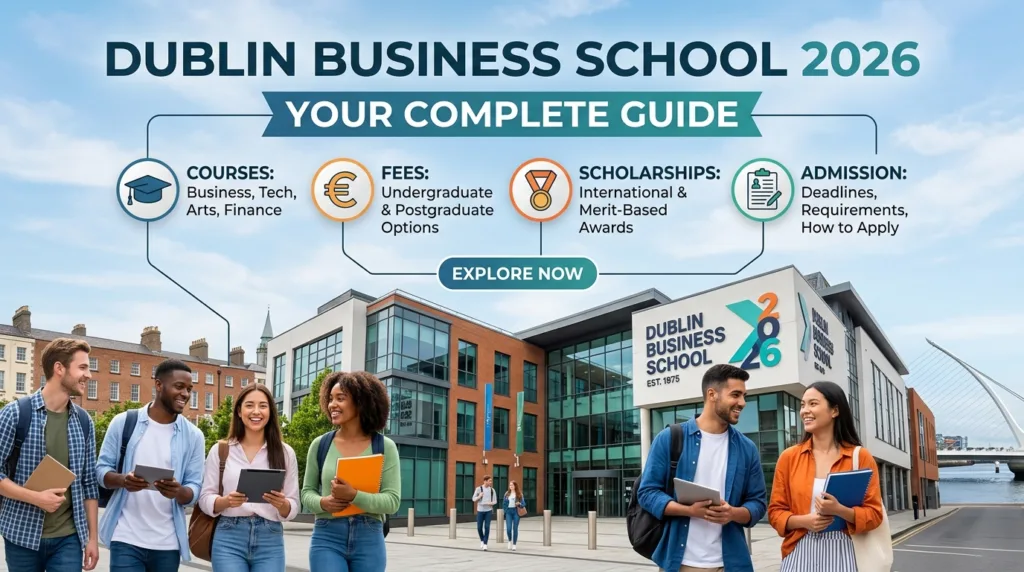
Dublin Business School (DBS) was first established in 1975. It was known as the Accountancy and Business College that offered evening courses to students preparing for professional accounting bodies exams. Due to its success and growing reputation, the school eventually expanded to offer full- and part-time courses in accounting, marketing, and banking.
Today, Dublin Business School is one of Ireland’s leading institutions, specialising in career-focused business and law education and delivering contemporary programmes in the areas of arts, media, social science, humanities, and psychology.
Table of Contents
About Dublin Business School?
Dublin Business School (DBS) has grown to become Ireland’s largest independent third-level college. Today, DBS is a cornerstone of private higher education in Ireland, hosting a vibrant community of over 9,000 students from more than 70 countries, including a significant and growing number of Nigerians. DBS has 3 campuses on Aungier Street, George’s Street, and Balfe Street in Dublin. Of these, there are 2 main campuses on Aungier Street and George’s Street. They are located close to each other and provide students with access to all the infrastructure capabilities of a modern capital city.
With more than 50 years of experience, DBS has built a global reputation for delivering career-focused education. Every degree at DBS is accredited by Quality and Qualifications Ireland (QQI), ensuring your qualification is recognised both in Nigeria and globally. The college has consistently been recognised at the Irish Education Awards, winning titles such as “Best College of Business” and “Overall Excellence in Education.” As part of the global Kaplan network, DBS maintains an unrivalled “Platinum” status for professional accountancy tuition (ACCA and CIMA).
DBS works closely with industry and professional bodies to ensure the quality and relevance of materials and the employability of graduates, driving meaningful, impactful careers.
| Feature | Detail |
| Status | Largest Independent College in Ireland |
| Main Campus | Aungier Street, Dublin 2 |
| Student Population | 9,000+ |
| International Diversity | 70+ Nationalities |
| Accreditation | QQI (Irish Government) |
Why Nigerian Students Should Seriously Consider Dublin Business School
Dublin Business School is located in Dublin 2, one of the most professionally active parts of the Irish capital. It has quietly built a reputation as a practical choice for Nigerian students seeking more than a degree after three or four years.
Here is what actually makes it worth considering.
You Graduate Job-Ready, Not Just Qualified
The gap between completing a degree and functioning in a professional environment is real, and most universities do little to close it. DBS takes a different approach.
Courses are built with input from industry, which sounds like marketing language until you realise it means your assignments and case studies are drawn from situations that Irish employers actually deal with. Beyond the coursework, DBS runs a programme called DBS Advantage alongside your degree. It focuses on things that rarely appear in a syllabus but matter enormously when you are job hunting: how to present yourself professionally, how to network in an Irish context, and how to handle interviews in a market that operates differently from what most Nigerian graduates are used to.
The campus location helps too. Dublin 2 is home to a significant number of Ireland’s major employers, including tech companies clustered around the area known as Silicon Docks and financial institutions in the International Financial Services Centre. Recruiters from these organisations visit DBS regularly, which simply would not happen if the college were based in a more remote location.
For Accounting and Finance Students, This Is Hard to Beat
If you are coming from Nigeria specifically to study accounting or finance, DBS deserves serious attention.
DBS is part of the Kaplan group, a global education company with deep roots in professional accountancy training. That ownership brings real resources and expertise to how accountancy is taught. More concretely, DBS holds Platinum status with the ACCA, which is the highest recognition the body awards to learning providers. DBS students consistently perform strongly in ACCA professional exams, including at the global level. For a Nigerian student seeking ACCA qualifications alongside an Irish degree, this combination is difficult to find elsewhere in Ireland.
You Can Enter at Whatever Level Makes Sense for You
Not every Nigerian student arrives with a straightforward academic record. Some have strong WAEC results but no university background. Others hold Nigerian degrees in a different field. Some left university partway through for reasons that made sense at the time.
DBS addresses most of these situations through a flexible entry and progression system. You can begin with a certificate, progress to an ordinary degree, and then complete an honours degree, gaining a recognised qualification at each stage rather than committing to a four-year programme from the start.
Nigerian university graduates are also frequently granted exemptions from certain modules or professional papers based on prior study, which can reduce overall time and cost. It is worth having a direct conversation with the admissions team about your specific background rather than assuming a fixed path applies to you.
The Location Is a Genuine Advantage, Not Just a Selling Point
Being based in the city centre means your daily environment during term time is Dublin itself, not a suburban campus with limited connections to professional life. The city’s libraries, cultural institutions, and social spaces are accessible on foot. Every major bus route and the Luas tram network run close to the campus, which gives you flexibility in where you choose to live without being penalised by long or expensive commutes.
For students who are working part-time alongside their studies, which most international students in Dublin do, the central location also makes it significantly easier to find work nearby.
There Is Already a Community There for You
DBS has been welcoming Nigerian students for long enough that the support structures are well established. The college works with a network of education agents across Nigeria, including in Lagos, Abuja, and Enugu, so you can receive reliable guidance on your application and visa documents before you leave the country.
On campus, students come from over 70 countries, and the African student community is one of the more active groups. That matters more than people sometimes acknowledge before they travel. Knowing there are people around who understand your background, who have already navigated the same paperwork, culture shift, and practical challenges, makes the first few months considerably less difficult.
Applications Move Quickly
For Nigerian students managing visa application timelines with their own deadlines and processing windows, the speed at which DBS processes applications is a practical advantage. Receiving an offer letter promptly gives you more time to sort your visa, finances, and accommodation without everything becoming a last-minute scramble.
That alone has been the deciding factor for many students choosing DBS over larger institutions whose application processes move more slowly.
DBS Tuition Fees for 2026/2027
Fees are usually the first thing people want to understand, and rightly so. Here is a clear breakdown of DBS costs for the 2026/2027 academic year, along with practical details that are not always included in the official brochure.
Undergraduate Fees
DBS uses a relatively straightforward pricing structure for undergraduate programmes, making budgeting easier than at institutions where fees vary significantly by course.
| Program Level | Typical Duration | Annual Tuition (Gross) |
| Higher Certificate (Level 6) | 2 Years | €10,050 – €10,350 |
| Bachelor’s Degree (Level 7) | 3 Years | €10,050 – €10,350 |
| Honours Bachelor’s (Level 8) | 3-4 Years | €10,365 – €10,500 |
The most popular Level 8 programmes among Nigerian students, including Business, Accounting and Finance, Computing, Law, and Psychology, generally cost €10,365 per year.
Postgraduate Fees
Postgraduate pricing varies more by programme type. Standard taught master’s degrees are priced differently from specialist, technology-focused MSc programmes, which command higher fees due to strong demand for those skills in the Irish job market.
| Program Level | Typical Duration | Annual Tuition (Gross) |
| Higher Diploma (Level 8) | 1 Year | €10,050 – €10,500 |
| Master of Arts / MSc (Standard) | Specialised MSc (Tech/Data) | €14,500 |
| Specialized MSc (Tech/Data) | 1 Year | €15,575 |
| MBA (All Streams) | 1 Year | €14,500 – €15,000 |
The higher MSc bracket of €15,575 applies to programmes in Data Analytics, Cybersecurity, Artificial Intelligence, FinTech, and Digital Marketing and Analytics. These are among the most employable qualifications you can hold in Dublin right now, which is part of why they cost more.
Additional Costs You Need to Budget For
The tuition figures above are not the complete picture. There are a few additional costs that are either mandatory or effectively unavoidable, and they matter when you are putting together your visa proof of funds.
The PEL Fee, which stands for Protection of Enrolled Learners, is a legal requirement under Irish education law. It exists to protect your fees in the unlikely event that a college closes or a programme is discontinued. For most DBS programmes, this is already built into the gross tuition figure quoted, though a slight increase is expected for 2026 entry.
Health insurance is mandatory for all non-EU students on an Irish student visa. Budget approximately €120 to €150 per year for a standard student health insurance plan. This is not optional, and the Irish Embassy will expect to see evidence of it as part of your visa application.
A QQI Award Fee of roughly €150 to €200 is charged once, in your final graduating year, to cover the cost of processing and issuing your official Irish qualification. It is a one-off cost, but worth knowing about so it does not catch you by surprise at the end of your programme.
Scholarships Available to Nigerian Applicants
DBS offers partial fee reductions that are accessible to Nigerian students without a lengthy or complicated application process.
For undergraduate applicants at Level 7 or Level 8, a discount of up to €500 is available on the first year of tuition. For postgraduate applicants, the reduction goes up to €1,000 off the programme fee. The main requirement to access either discount is straightforward: pay your acceptance deposit, which is typically €1,000, within 30 days of receiving your offer letter.
Students who move quickly tend to secure these savings without much difficulty. Students who delay often miss it.
These are not full scholarships, but for a student managing a tight budget, €500 to €1,000 off is a meaningful reduction and worth factoring into your decision timeline.
How to Actually Pay Your Fees From Nigeria
This is the part that catches people off guard more than any other, and it is worth addressing directly.
DBS strongly recommends paying through either Flywire or TransferMate rather than through a traditional Nigerian bank transfer. The reasons are practical rather than bureaucratic. Both platforms offer significantly better exchange rates than Nigerian commercial banks, which means the naira cost of your fees is lower than it would be through a standard wire transfer. More importantly, both platforms generate a payment receipt that is formatted specifically for Irish Embassy requirements, which your visa officer in Abuja or Lagos will expect to see as part of your financial documentation.
Setting up a Flywire or TransferMate payment is straightforward and can be done online before you travel. It is one of those small logistical details that is worth sorting out early rather than scrambling to figure out under visa application pressure.
Irish Study Visa Guide for Nigerian Students Applying to DBS
The visa process is where a lot of Nigerian students hit unexpected delays, and most of those delays come down to documentation issues that were entirely avoidable. This section breaks down exactly what you need, what the Embassy looks for, and how to give your application the best possible chance.
The Type of Visa You Are Applying For
You are applying for a Standard Irish Study Visa, which gives you a Stamp 2 permission to live and study in Ireland. Applications from Nigeria are submitted through the VFS Global centres in Lagos or Abuja, not directly at an Embassy. The Irish Embassy in Abuja and the Consulate in Lagos both maintain rigorous standards for financial documentation, so getting your paperwork right the first time saves weeks of back-and-forth.
Proof of Funds: What the Numbers Actually Mean
This is the part that trips people up most often, so it is worth being very specific.
The Irish Naturalisation and Immigration Service requires you to demonstrate that you can financially support yourself throughout your studies without depending on part-time work or public funds. The standard financial threshold works like this.
You need to show evidence of at least €10,000 per year for your living expenses. This is separate from your tuition fees and must be available in addition to them.
You also need to provide a receipt from DBS confirming you have paid at least €6,000 toward your tuition. That said, for Nigerian applicants, paying the full first-year tuition upfront is strongly recommended rather than the minimum. Embassy officers look at financial documentation as an indicator of genuine intent and stability. A full tuition payment signals both. A minimum payment can raise questions.
Putting it simply, your bank statement should ideally show the full first year tuition plus at least €10,000 sitting on top of that.
How Your Bank Statements Will Be Assessed
The Embassy requires six months of bank statements. They are not just looking at the balance. They are looking at the history behind it.
A steady account with consistent activity over the six-month period reads as credible. An account that shows a very low balance for five months and then a large sum appearing shortly before the application date raises immediate questions. These sudden deposits, often called lump sums, are one of the most common reasons Nigerian visa applications are delayed or refused.
If a large amount did legitimately arrive in your account recently, you need to explain it with documentation. A letter from a bank confirming a loan, evidence of a property sale, business dividend records, or any other legal paper trail that accounts for where the money came from. Without that explanation, Embassy officers have no way to verify that the funds are genuinely available to you.
If your parents or a guardian are sponsoring your studies, their financial documentation carries the same weight as yours and must be equally clean and well-supported. You will need their six-month bank statements, a notarised Affidavit of Support, your birth certificate as proof of your relationship to them, and evidence of their employment or business ownership. Sponsorship applications that arrive with incomplete family documentation are treated the same as any other incomplete file.
Your Full Document Checklist
When you visit the VFS Global centre in Lagos or Abuja, bring the following.
Your Summary Application Form, printed from the AVATS online portal after completing your application.
Your Letter of Acceptance from DBS. This needs to be an unconditional full offer, not a conditional one. Make sure your place is fully confirmed before you apply for the visa.
Your fee payment receipt from Flywire or TransferMate. As covered in the fees section, these platforms generate Embassy-ready receipts that the visa officer expects to see. A standard bank transfer receipt may not be accepted in the same way.
Your original academic certificates. For undergraduate applicants, this means your WAEC or NECO certificates. For postgraduate applicants, your university transcripts and degree certificate.
A Statement of Purpose. This is a two to three-page personal letter that explains why you chose DBS specifically, why you chose Ireland as a study destination, what you intend to do with your qualification, and your plans to return to Nigeria after your studies and post-graduation work permission expire. This document matters more than most applicants realise. A vague or generic Statement of Purpose is a red flag. A specific, honest, and well-structured one builds the officer’s confidence in your application.
Evidence of private medical insurance. DBS can usually arrange this for students for around €120 to €150.
A Nigerian Police Character Certificate. This is not always listed as mandatory for the initial application, but having it ready is strongly recommended. Some applications require it, and not having it causes delays that could have been avoided.
How Long the Visa Take and When to Apply
Processing times for Nigerian applicants currently run between eight and twelve weeks. That window is not guaranteed and can extend during busy periods, so building extra time into your planning is not optional; it is necessary.
If you are aiming for the September intake, your visa application should be submitted no later than the end of June, and earlier if at all possible. Submitting in July is cutting it close and leaves very little room if anything needs to be resubmitted or clarified.
For the January intake, aim to have your application in by October.
Missing these windows does not just mean a late start. It can mean losing your place for that intake entirely and having to defer to the following one. The entire process, from getting your offer letter to submitting your visa application, takes longer than most people expect when they plan it out for the first time. Start earlier than feels necessary.

Ready to start your study abroad journey?
Chat with our StudyAbroadly advisors for free guidiance tailoredto Nigerian students
Cost of Living and Employment Opportunities in Dublin
Dublin Business School (DBS) is located in the heart of Dublin 2; your lifestyle will be centred in Ireland’s most expensive city. However, being in the “Silicon Docks” of Europe also provides enough opportunities for part-time and post-graduate jobs.
Monthly Cost of Living (Dublin 2026 Estimates)
Living in Dublin requires careful budgeting. While the city is vibrant, Nigerian students often save by living in “commuter towns” (like Tallaght, Clondalkin, or Swords) and using public transport to reach the Aungier Street campus.
| Expense Category | Monthly Estimate (Student Budget) |
| Accommodation (Shared Room) | €750 – €1,100 |
| Food & Groceries | €250 – €350 |
| Utilities (Heat/Electricity/Internet) | €90 – €130 |
| Transport (Student Leap Card) | €65 – €85 |
| Mobile & Data Plan | €20 |
| Socializing & Leisure | €150 – €200 |
| Total Monthly Budget | €1,325 – €1,885 |
Part-Time Work (During Your Studies)
As a full-time international student at DBS, you are legally allowed to work to help cover your living expenses. You do not need a separate work permit; your student visa is sufficient.
- Working Hours: Up to 20 hours per week.
- Holiday Periods: Up to 40 hours per week (during June, July, August, September, and mid-December to mid-January).
- 2026 Minimum Wage: The Irish national minimum wage is €14.15 per hour.
A student working 20 hours a week can earn approximately €1,132 per month before tax. In a city like Dublin, this can cover a significant portion of your rent and groceries.
The “Stay-Back” Graduate Visa (Stamp 1G)
Ireland offers one of the most generous post-study work pathways in Europe. Once you complete your exams at DBS, you can apply for the Third Level Graduate Scheme.
- Bachelors (Level 8): 12-month stay-back visa.
- Masters & PhD (Level 9/10): 24-month (2-year) stay-back visa.
This period allows you to work full-time (40 hours/week) for any employer. If you secure a role with a salary above a certain threshold (usually €34k–€38k depending on the sector), your employer can then sponsor you for a Critical Skills Employment Permit, leading to permanent residency.
Key Employment Sectors for DBS Graduates:
- Tech & Data: Dublin is home to the European HQs of Google, Meta, TikTok, and Microsoft. DBS graduates in Data Analytics and Cybersecurity are in high demand.
- Financial Services: With your degree being so close to the IFSC (International Financial Services Centre), roles in accounting, FinTech, and risk analysis are abundant.
- Business & Project Management: Many Irish firms hire DBS graduates for operations and digital marketing roles.
The DBS Careers Hub
DBS provides an active support system to help you bridge the gap between Nigeria and the Irish workforce:
- CV Workshops: Tailoring your resume to the Irish format (which differs from the Nigerian style).
- Mock Interviews: Practising for the behavioural interview style common in European companies.
- Networking Events: Monthly meetups where employers come to the campus to meet students.
StudyAbroadly: Your Expert Gateway to Dublin Business School (DBS)
Applying to a world-class Irish institution like Dublin Business School (DBS) from Nigeria is a life-changing milestone, but navigating the “Ancient University” system and Irish visa regulations solo can be genuinely daunting. StudyAbroadly is here to take that weight off your shoulders, guiding you through every step with expert care.
StudyAbroadly is a premier Nigeria-based study abroad consultancy that specialises in helping ambitious students gain admission to prestigious universities in Ireland, the UK, Canada, and the USA. We have a deep partnership with Irish institutions and understand the specific nuances of the DBS application process from the inside.
What StudyAbroadly Offers for DBS Applicants
- Free Initial Consultation: We assess your WAEC/NECO or University transcripts to see if you meet DBS’s competitive entry requirements.
- Personalised Program Shortlisting: Based on your career goals—whether in Cork’s famous Pharma hub or its thriving Tech sector—we find the perfect DBS course for your budget.
- Expert Application Support: We help you craft a standout Statement of Purpose (SOP) that reflects DBS’s values of “Independent Thinking.”
- Strategic Document Review: From English proficiency waivers to transcript translations, we ensure your submission meets DBS’s rigorous standards.
- Automatic Scholarship Guidance: We help you identify and secure merit-based tuition discounts (up to 20%) that you may not have known about.
- Detailed Visa & Proof of Funds Support: We provide expert coaching on the €10,000 living expense rule and bank statement formats to ensure a “Yes” from the Irish Embassy.
- Pre-Departure Briefings: Before you fly, we brief you on everything from opening an Irish bank account to surviving your first Cork winter.
- Post-Arrival Community: We connect you with our network of Nigerian students already thriving at DBS, so you have a “home away from home” the moment you land.
Why Choose StudyAbroadly for Your DBS Journey?
The honest answer? Having an expert in your corner who has successfully navigated the Irish system saves you time, money, and stress. A single mistake in your visa documents or a “lump sum” in your bank statement can cost you your dreams or cause you to miss the September intake. StudyAbroadly has a proven track record of helping Nigerian students avoid these pitfalls.
Our team understands both the Irish Higher Education system and the unique challenges of applying from Nigeria. Whether it’s converting your GPA, verifying your WAEC results through the right channels, or understanding scholarship eligibility for the College of Medicine or Business, proper guidance makes a measurable difference.
If you are serious about securing your future at Dublin Business School, reaching out to StudyAbroadly early in the process gives you the best possible start.
Frequently Asked Questions (FAQ)
Can I work while studying at DBS?
Yes. Your Stamp 2 Visa allows you to work 20 hours per week during school and 40 hours during holidays. The minimum wage is currently €13.50 per hour.
Does DBS provide accommodation?
While DBS does not own dorms, they have a dedicated accommodation officer to help you find student residencies or “host family” setups in Dublin.
What is the “Stay Back” option?
After graduating from DBS, you get a Stamp 1G visa. This lets you stay and work full-time in Ireland for 1 year (after a Bachelor’s) or 2 years (after a Master’s).