
MRes degrees for international students living in the UK can provide an opportunity for international graduates who want to develop advanced research skills without leaving the country. An MRes, or Master of Research, can work well for someone who has recently completed a bachelor’s or master’s programme, as well as a Graduate visa holder planning to continue with further study.
The attraction of an MRes goes beyond gaining another qualification. Most programmes place considerable attention on research methods, independent investigation and a substantial research project. That makes the degree relevant to graduates planning doctoral study, academic research or careers where research skills form a large part of the work.
International students already living in the UK also have an immigration point to consider. GOV.UK confirms that people already in the UK may be able to switch to a Student visa from another eligible visa, provided they meet the Student visa conditions. The application must be made before the current visa expires, and the new course must begin within 28 days of that expiry date. An unconditional offer and CAS from a licensed student sponsor are also needed.
The Graduate visa itself cannot be extended, but switching to another eligible visa can provide a way to continue living in the UK. Under the current rules, a Graduate visa lasts for two years for applications made on or before 31 December 2026, while applications made from 1 January 2027 receive 18 months, with doctoral graduates receiving three years.
For international students considering this route, the choice of MRes should match both academic plans and immigration timing.
What Makes an MRes Different?
An MRes places research at the centre of the degree. Students spend time learning research methods, developing a research question, reviewing existing academic work and carrying out an extended research project. That format can work well for graduates who already have a clear area of interest. Someone with a background in psychology may prefer a psychology research degree, while a healthcare professional may find an MRes in health and care more relevant. The degree can also provide preparation for doctoral study.
Admission Criteria for MRes Study
Most MRes applications involve more than a previous degree certificate. Universities want to see that the applicant has an academic background suited to research and a clear idea of the area they want to investigate.
A standard application can include:
- A completed bachelor’s degree, often with a 2:2 or above
- A relevant master’s qualification where the course calls for one
- Academic transcripts
- A personal statement
- A research proposal or outline
- Evidence of English language ability where applicable
- A current CV for some research programmes
The research proposal can be particularly important. Some courses ask applicants to submit an outline of the topic they would like to investigate so the university can assess the fit with its research areas and supervision available.
MRes Courses in the UK
The right MRes depends heavily on your previous degree and your plans after graduation. Some areas are especially suitable for students who already have a background in a related field.
Leadership and Management
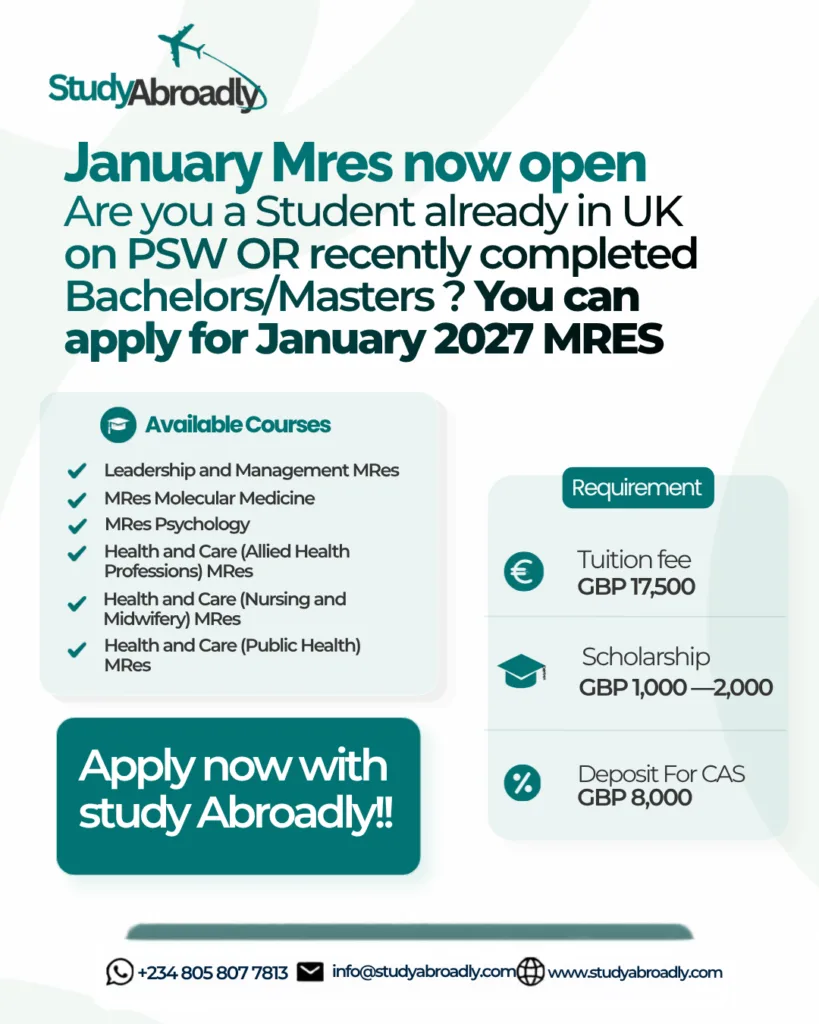
This area is relevant to graduates interested in organisational strategy, leadership, business research and management. The University of Derby offers an MRes in Leadership and Management, with a full time route lasting one year and an international fee of £17,500. The programme has September and January starts.
Molecular and Medical Research
Students with backgrounds in biomedical science, life sciences, medicine or related subjects can consider research degrees in molecular and medical fields. Bangor University offers an MRes in Molecular Medicine that combines laboratory research with research training and is designed for students considering careers in scientific research.
Newcastle University has a wider selection of Medical Sciences MRes programmes, including Medical and Molecular Biosciences, Immunobiology, Medical Genetics, Neuroscience, Regenerative Medicine and Stem Cells, and Translational Medicine and Therapeutics.
Psychology
Psychology can be a suitable MRes area for graduates interested in behavioural research, quantitative methods, experimental work or further academic study. Derby currently offers a Psychology MRes with September and January starts. The programme focuses on original psychology research and gives students experience with both quantitative and qualitative methods. Bangor University also offers Masters by Research opportunities within its Psychology research area, alongside its broader postgraduate research programmes.
Health and Care
Health related MRes degrees are relevant to professionals and graduates building careers in nursing, midwifery, public health and allied health research.
Derby offers MRes programmes in Health and Care covering Nursing and Midwifery, Public Health and Allied Health Professions. Some of these programmes have several annual start points, including September, January, April and June. The international fee shown for several of these programmes is £17,500. Keele University also offers an MRes in Health and Care, with research areas covering medicine, nursing, pharmacy, physiotherapy, radiography, social work and other health disciplines.
Health and Social Care Research
The University of Essex offers an MRes in Health and Care Research. The programme is aimed at health and social care practitioners interested in research careers and further study.
UK Universities to Consider for an MRes
University of Derby
Derby has one of the broadest selections in this group for students interested in business, psychology and health related research. Current MRes options include Leadership and Management, Psychology, Health and Care, Nursing and Midwifery, Public Health and Allied Health Professions.
Bangor University
Bangor is worth considering for students interested in scientific research and psychology. Its MRes in Molecular Medicine has a laboratory research component and is designed around scientific research training. Its Psychology research area also includes Masters by Research study, making the university relevant for students interested in behavioural and psychological research.
Keele University
Keele’s MRes in Health and Care is aimed at graduates interested in research across healthcare, social care and related disciplines. The programme includes access to research environments connected with the NHS and other organisations.
University of Essex
Essex offers the MRes Health and Care Research at its Colchester campus. The programme is suitable for health and social care practitioners who want to move further into research.
Newcastle University
Newcastle has a broad suite of Medical Sciences MRes programmes. Current options include Medical and Molecular Biosciences, Immunobiology, Medical Genetics, Neuroscience, Regenerative Medicine and Stem Cells, Translational Medicine and Therapeutics, and several other specialist research areas. The university describes these MRes programmes as one year courses combining taught study with a substantial research project.
University of Greater Manchester
The University of Greater Manchester, formerly the University of Bolton, offers an MRes in Leadership and Strategy. The programme lasts 18 months and combines research methods with an independent research project.
Tuition Fees, Deposits and Start Dates
MRes costs are not fixed across the UK. The fee depends on the university, subject and study format. Current published figures show international fees of £17,500 for several Derby MRes programmes, £18,200 for Keele’s Health and Care MRes, and £17,500 for the University of Greater Manchester’s Leadership and Strategy MRes.
A single £8,000 CAS deposit should not be presented as a universal MRes figure. Tuition deposits are set by individual universities and can differ across institutions and applicant groups.
Start dates also differ considerably. Derby has programmes starting in September, January, April and June, while Keele’s Health and Care MRes currently shows September and the University of Greater Manchester’s Leadership and Strategy MRes has September and January options. Students already living in the UK should check the exact course page before making immigration or financial plans.
Where StudyAbroadly Fits Into Your MRes Plan
StudyAbroadly can help students bring the academic and application sides together before they commit to a course. This can include reviewing academic backgrounds, identifying suitable MRes options, checking entry criteria, preparing university applications and helping students understand the documents needed for the next stage.
Students already living in the UK can also receive guidance around course selection and the timing of a Student visa application. The final immigration decision remains with UK Visas and Immigration, so students should always check the latest government rules alongside university guidance before submitting an application.
Is an MRes a Good Route After a UK Master’s?
An MRes can make sense for a graduate who wants more research experience before moving into doctoral study or a research based career. It is also useful for professionals whose work involves data, investigation, evaluation or evidence based decision making. The course should fit the student’s previous degree and research interests. A psychology graduate may have more options in psychology research, while a healthcare professional could find an MRes in health and care more relevant.
For international students already in the UK, timing adds another consideration. The course start date, university application deadline and current visa expiry date all need to fit together.