
If you have been looking at UK universities and keep seeing GCU come up, there is a good reason for that. Glasgow Caledonian University has built a solid reputation as a practical, career-first institution. GCU was founded in 1993 through the merger of The Queen’s College Glasgow and Glasgow Polytechnic. Today it sits in the heart of Glasgow, one of Scotland’s most vibrant cities, and operates a second postgraduate campus in London. It describes itself as the “University for the Common Good,” a mission that runs through everything from its scholarship programs to its community projects.
It serves students from over 100 countries worldwide. Nigerian students in particular have found it to be a welcoming, affordable, and career-relevant option in the UK.
Table of Contents
Quick Facts About Glasgow Caledonian University
| Founded | 1993 |
| Main Campus | Glasgow, Scotland |
| Second Campus | London (Postgraduate only) |
| UK Ranking | #85 in the 2026 Complete University Guide |
| Graduate Employability | 91% employed or in further study within 15 months |
| International Students From | Over 100 countries |
| University Motto | University for the Common Good |
Why Choose GCU? Campus Life & Career Opportunities
The Campus Experience
GCU’s main campus is located in the city centre of Glasgow, which means you are not isolated on some remote campus. You step outside and you are immediately in the middle of a thriving city with great food, transport links, music venues, and a cultural scene that is hard to beat in Scotland. Glasgow itself is regularly ranked as one of the friendliest cities in the UK, which makes all the difference when you are thousands of miles from home.
The campus is modern and compact, with well-equipped labs, a large library, student union facilities, and sports amenities. Everything is walkable, which makes daily student life a lot more manageable compared to larger, spread-out campuses.
The London campus offers a different experience, placing postgraduate students in the heart of one of the world’s most connected business cities. It is a smaller environment built specifically for Masters students who want that London edge.
Career Outcomes
With 91% of its graduates in employment or further study within 15 months of completing their degree, the university takes employability seriously. Programs are built with industry in mind, many feature work placements, live project briefs, and professional accreditations that employers recognize immediately.
For Nigerian students specifically, a UK degree from GCU carries significant weight. Whether you plan to return home, build a career in the UK with your post-study work visa, or move on to another country, the qualification opens doors.
What Makes GCU a Good Fit for Nigerians
- Tuition fees that are lower than many comparable UK universities
- Automatic scholarships that reduce costs without extra paperwork
- Focus on practical, professional programs
- Active international student community
- Location in Glasgow, a city with a manageable cost of living compared to London
- Two-year post-study work visa for graduates, giving you time to build UK experience
Fields of Study and Programs Offered
GCU groups its programs under four main academic schools. Below is an overview of what is available at each level of study.
Undergraduate Programs
Undergraduate degrees at GCU last three to four years, depending on the course and if you choose a placement year. Programs are available in:
- Business, Management and Finance
- Computer Science, Cybersecurity and Data Science
- Engineering (Civil, Mechanical, Electronics)
- Nursing, Midwifery and Health Sciences
- Law and Social Sciences
- Fashion, Retail and Marketing
- Psychology and Counselling
- Construction and Surveying
Annual fees for international undergraduate students start at £15,700 per year.
Postgraduate Taught (Masters / MSc)
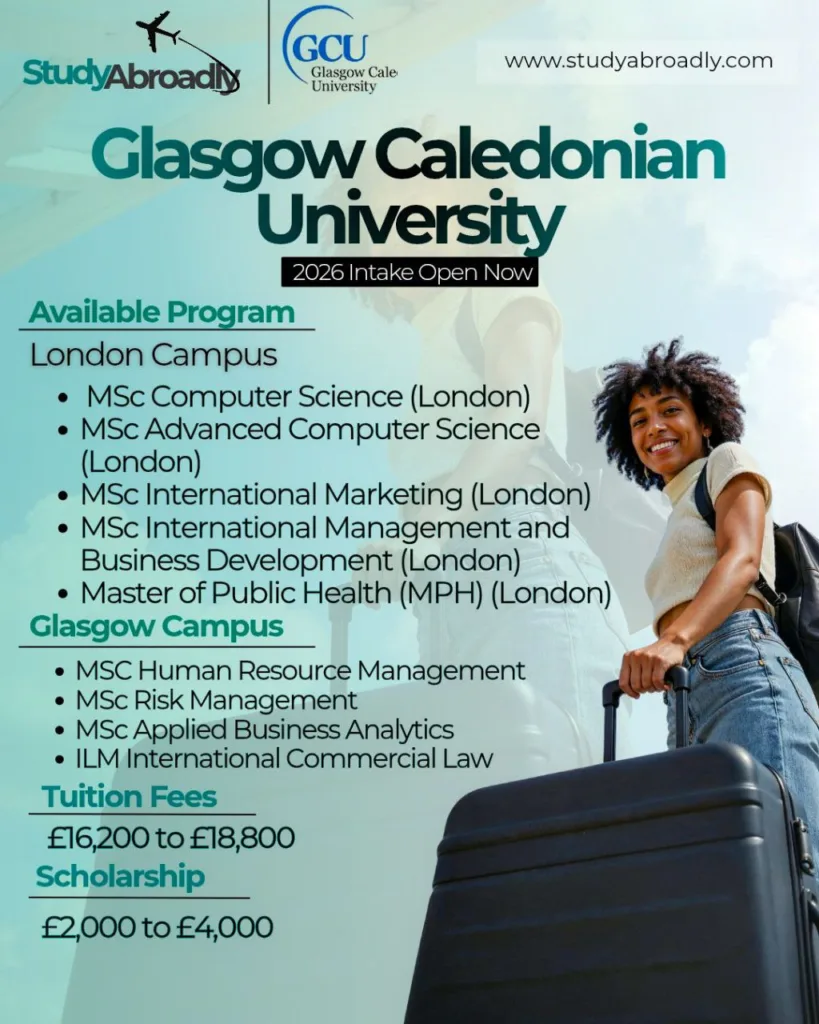
GCU offers a wide range of one-year full-time MSc and MBA programs across its schools. These are taught postgraduate degrees and are the most popular choice among Nigerian students due to the shorter duration and career focus.
Popular Masters programs include:
- MSc International Business Management
- MSc Finance
- MSc Data Science
- MSc Cybersecurity
- MSc Construction Project Management
- MSc Public Health
- MSc Occupational Therapy
- MBA (Master of Business Administration)
- MSc Fashion Management (London campus)
MSc fees range from £16,700 to £20,400 per year. The MBA goes up to £20,400.
Postgraduate Research (MRes / MPhil)
For students interested in research without committing to a full PhD, GCU offers Masters by Research (MRes) and MPhil programs. These are supervised research degrees, and fees and availability depend on the specific research area and department. It is best to contact GCU’s admissions directly to discuss research opportunities and supervisory availability.
Doctorate (PhD)
GCU offers PhD programs through its research institutes and academic schools. As with the MRes, PhD fees and funding vary depending on the research topic, department, and whether you are applying for a funded project or a self-funded position. Some PhD opportunities come with funding from research councils or external sponsors. Nigerian students considering a PhD should check GCU’s current PhD vacancies and contact potential supervisors before applying.
Tuition Fees, Deposit and Scholarships
International Tuition Fees for 2026/2027
| Level of Study | Annual Fee (International) | Notes |
| Undergraduate | From £15,700 | Per year, full-time |
| MSc / Taught Masters | £16,700 – £20,400 | Per year, most programs |
| MBA | £20,400 | Full program fee |
| MRes / MPhil / PhD | Contact GCU directly | Varies by research area |
The £6,000 Deposit
Before GCU issues your Confirmation of Acceptance for Studies (CAS), which is the document you need to apply for your UK student visa, you will need to pay an initial deposit of £6,000. This deposit is deducted from your total tuition fee, so it is not an extra cost. It is just part of your payment. Make sure you plan your finances to have this amount ready well before your visa application deadline.
Scholarships Available to Nigerian Students
New to GCU Postgraduate Scholarship (Up to £3,000 off). If you are applying to a full-time taught Masters at GCU for the first time, you may automatically receive a tuition fee discount of up to £3,000. No separate application is needed. GCU assesses eligibility automatically when you apply.
GCU Plus (Additional £1,000, Total £4,000 off). Nigerian students with a brilliant academic record or high English language test scores may qualify for an additional £1,000 discount on top of the standard postgraduate scholarship, bringing the total discount to £4,000.
New to GCU Undergraduate Scholarship (Up to £2,500 off per year). International students starting an undergraduate program at GCU can receive up to £2,500 off their annual tuition fees. This scholarship is awarded each year of study.
Early Payment Discount (5% off total tuition). Pay your full tuition fees before the specified deadline and GCU will give you a 5% discount on the total amount. This can save a meaningful amount, especially at the MSc and MBA level.
GCU London Postgraduate Ambassador Scholarship (Full Tuition). This is GCU’s most competitive scholarship, offered occasionally to May intake applicants for the London campus who can demonstrate a commitment to the Common Good ethos. This covers the full tuition fee.
Application Requirements, Visa and Proof of Funds
How to Apply to GCU
Undergraduate applications go through the UK’s central applications system. Postgraduate applications are made directly through GCU’s application portal.
You will need:
- Academic transcripts and certificates from all previous institutions
- Personal statement (for undergraduate; for postgraduate, a statement of purpose)
- Two academic or professional references
- Valid international passport (photo page)
- English language qualification
- CV or resume (for most postgraduate applications)
Academic Entry Requirements
Undergraduate
GCU expects the equivalent of UK A-level qualifications. For Nigerian students, this usually means a WAEC/NECO result with good grades (A-C) in relevant subjects, along with a completed foundation year program.
Postgraduate (Masters)
You will need a bachelor’s degree from a recognized university. GCU accepts degrees equivalent to a UK 2:1 or 2:2 depending on the program. Nigerian degrees from accredited institutions are generally accepted. If your grade falls slightly below the standard threshold, some programs may still consider your application based on work experience.
English Language Requirements
As an international student from Nigeria, you are required to prove your English language ability. GCU accepts the following:
| Test | Minimum Score Required |
| IELTS Academic | 6.0 – 6.5 overall (varies by program) |
| TOEFL iBT | 72 – 90 (varies by program) |
| PTE Academic | 51 – 58 |
| Duolingo English Test | Accepted for some programs |
Some programs with clinical or professional placement components may have higher language thresholds. Always confirm with the specific department.
UK Student Visa Requirements
Once you receive an unconditional offer and pay your deposit, GCU will issue your CAS (Confirmation of Acceptance for Studies). You then use this CAS number to apply for a UK Student visa through UKVI.
Important documents for the UK Student visa application:
- Valid Nigerian international passport (at least 6 months validity beyond your intended stay)
- CAS reference number from GCU
- Proof of English language proficiency
- Academic qualifications
- Proof of funds
- Passport-sized photographs
- ATAS certificate (if studying certain sensitive subjects)
Proof of Funds (POF)
The UK Home Office requires you to show that you can cover both your tuition fees and living costs. Here is how it breaks down for Nigerian students applying to GCU:
- You must show funds for the first year of tuition fees (after deducting the £6,000 deposit already paid to GCU)
- PLUS £1,529 per month for up to 9 months of living costs if studying in London, or £1,171 per month for up to 9 months if studying outside London (Glasgow falls under this)
- These funds must have been in your bank account (or a sponsor’s account) for at least 28 consecutive days before you submit your visa application
- Acceptable sources include personal savings, parental support, or a sponsor. The funds can be held in a Nigerian bank account, converted to GBP equivalent at the time of application
Cost of Living in Glasgow
Glasgow is one of the more affordable cities in the UK for students. Compared to London or even Edinburgh, your money goes a lot further here. That said, you still need to budget carefully.
| Expense | Estimated Monthly Cost |
| Accommodation (shared/university halls) | £600 – £900 |
| Food and groceries | £150 – £250 |
| Transportation (bus/subway) | £60 – £80 |
| Utilities (if not included in rent) | £50 – £80 |
| Mobile phone and internet | £20 – £40 |
| Leisure and social activities | £50 – £100 |
| Books and study materials | £20 – £40 |
| Approximate Total Per Month | £950 – £1,490 |
GCU has on-campus and affiliated student accommodation options. Applying early significantly improves your chances of getting a spot. Private accommodation is also available near campus and generally well-connected by public transport.
Scotland also has some student-specific discounts. The Young Scot card and student railcards can reduce transport costs, and many museums and attractions in Glasgow are free.
Work and Study Opportunities
Working While Studying
As an international student at GCU on a valid UK Student visa, you are permitted to work up to 20 hours per week during term time and full-time during official holiday periods. This is an advantage for Nigerian students looking to supplement their income and gain UK work experience.
GCU’s Glasgow location means there are job opportunities in retail, hospitality, healthcare support, tutoring, and customer service. The student union also has part-time positions on campus.
Post-Study Work Visa (Graduate Route)
After completing your degree, GCU graduates are entitled to apply for the UK Graduate Route visa, which allows you to stay in the UK and work (or look for work) without sponsorship for:
- 2 years after completing an undergraduate or Masters degree
- 3 years after completing a doctorate (PhD)
Internships and Placements
Many GCU programs incorporate professional placements, live industry projects, or internship opportunities as part of the curriculum. The university has partnerships with companies in finance, engineering, healthcare, and tech, and its careers service actively supports students in finding internships and graduate positions.
StudyAbroadly: Best UK Study Abroad Agency in Nigeria
Applying to a UK university from Nigeria is a huge milestone, but handling the process solo can be genuinely daunting. StudyAbroadly is here to take that weight off your shoulders, guiding you through every step with expert care.
StudyAbroadly is a Nigeria-based study abroad consultancy that helps Nigerian students gain admission to reputable universities in the UK, Canada, USA, and other countries. We have worked with students applying to institutions like GCU and understand the full process from the inside.
What StudyAbroadly Offers
- Free initial consultation to assess your profile and identify suitable universities and programs
- Personalized university shortlisting based on your grades, career goals, and budget
- Application support, including helping you review your personal statement and statement of purpose
- Document review to make sure everything you submit meets the university’s requirements
- Scholarship guidance to help you access discounts and funding you may not have known about
- Visa application support, including proof of funds guidance and interview preparation
- Pre-departure briefings so you know exactly what to expect when you arrive in the UK
- Post-arrival support and community connections with other Nigerian students abroad
Why Use an Agency Like StudyAbroadly?
The honest answer is that having someone in your corner who has done this before saves you time, money, and stress. Mistakes in your application, visa documents, or proof of funds can cost you your visa or cause you to miss an intake. StudyAbroadly has a track record of helping Nigerian students avoid these pitfalls.
Our team understands both the UK admissions system and the specific challenges that come with applying from Nigeria. Things like converting academic records, translating transcripts, bank statement formats, and understanding scholarship eligibility are all areas where proper guidance makes a measurable difference.
If you are serious about studying at GCU, reaching out to StudyAbroadly early in the process gives you the best possible start.
Frequently Asked Questions
Can I apply to GCU with my Nigerian degree for a Masters?
Yes. GCU accepts Nigerian degrees from accredited universities for postgraduate admission. A minimum of a second class lower (2:2 equivalent) is generally required, though some programs ask for a 2:1 equivalent. If your grade is borderline, relevant work experience can sometimes strengthen your application.
What is the GCU scholarship deadline for Nigerians?
The automatic postgraduate scholarships (up to £3,000 or £4,000 with GCU Plus) do not have a separate application deadline because they are assessed automatically. However, the earlier you apply, the better. For intake in September, GCU recommends applying well before May. For the GCU London Ambassador Scholarship, this is a competitive, time-limited award and you should check GCU’s website for current open rounds.
Can I work part-time while studying at GCU?
Yes. International students on a UK Student visa can work up to 20 hours per week during term time and full-time during vacations. Glasgow has enough student-friendly job opportunities in retail, hospitality, and admin to make this a realistic option.
Is Glasgow safe for Nigerian students?
Glasgow is generally a safe city and a welcoming one. GCU’s campus is in a central, well-connected area.
What is the post-study work visa situation for GCU graduates?
GCU graduates are eligible for the UK Graduate Route visa, which allows you to live and work (or look for work) in the UK for two years after a bachelor’s or Masters degree, or three years after a PhD.
Does GCU have a January or May intake?
GCU’s main intake is in September. Some programs, particularly on the London campus, offer January or May start dates.
What English test does GCU accept?
GCU accepts IELTS Academic, TOEFL iBT, PTE Academic, and in some cases Duolingo English Test. The minimum score varies by program but is generally IELTS 6.0 to 6.5 overall. Some programs with healthcare or clinical components may require higher scores.
Do I need to travel to the UK before applying?
No. The entire application process, from submitting your application to receiving your offer and paying your deposit, can be done online from Nigeria. You will only travel to the UK after your student visa has been approved.