Finland has built one of the most respected education systems in the world, and that reputation extends well beyond its universities. The country’s vocational training network produces graduates who move directly into skilled employment across healthcare, engineering, hospitality, technology, and industrial trades, often with job placement rates that academic degree programmes struggle to match. For international students who want a qualification, a direct path into the Finnish workforce, and a foothold in one of Northern Europe’s most stable economies, vocational schools in Finland is worth examining seriously.
The regulatory framework shifted in August 2026. Historically, vocational schools in Finland was entirely free for everyone regardless of nationality. That changed when the Finnish government introduced tuition fees for non-EU and non-EEA students entering English-taught programmes. Fees now typically run from €7,000 to €10,000 per academic year for international students without a qualifying residence permit. That figure places Finnish vocational education in a different financial bracket from where it sat even a year ago, but it remains competitive when measured against vocational training costs in the UK, Australia, or Canada.
The pathway into Finnish vocational education also works differently from what most international students expect. The general joint application system, called Opintopolku, is designed for Finnish high school leavers and does not serve international applicants well. Instead, international students apply directly through each school’s official website via their Continuous Admission portals, known in Finnish as Jatkuva haku. Each institution manages its own intake windows, requirements, and English proficiency standards independently, which means the process varies from school to school.
Here are the vocational schools in Finland offering English-taught programmes for international students.
Vocational Schools in Finland Offering English-Taught Programmes for International Students
Vamia
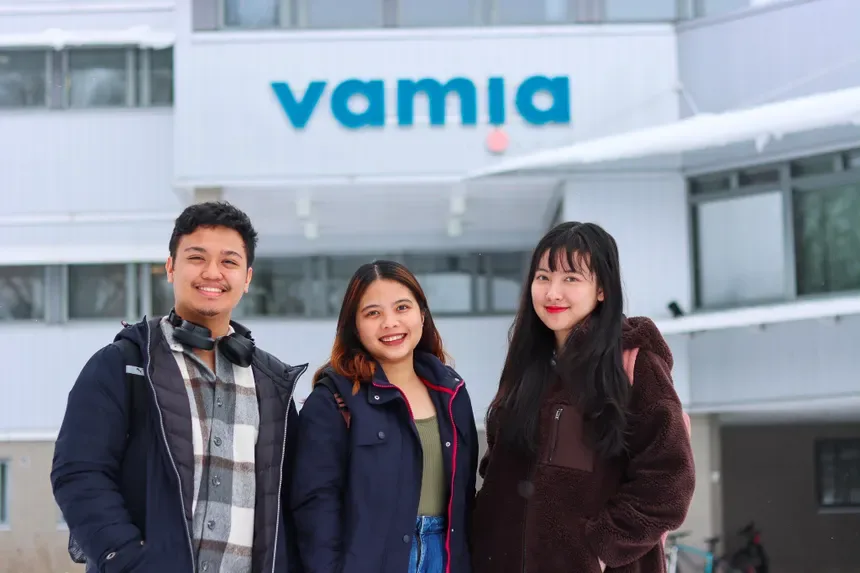
Based in Vaasa on Finland’s western coast, Vamia offers English-taught programmes in Restaurant and Catering Services, covering cook and waiter tracks, and Mechanical Engineering and Production Technology, covering plater-welder and machinist roles. Applications run on a rolling intake basis through direct submission, and the minimum requirements include being at least 18 years old and scoring a minimum of 85 on the Duolingo English Test. The rolling intake model is an advantage for international applicants, removing the pressure of fixed annual application windows.
Riveria
Operating across Joensuu and the North Karelia region, Riveria has built an internationally distinctive programme catalogue that pairs Hospitality and Catering Services with a Game Education track covering 3D graphic production and game design. That combination of traditional trades and creative technology disciplines makes Riveria one of the more unusual vocational institutions on this list. Applicants need a high school or secondary school-leaving certificate, a valid passport, and a minimum Duolingo English Test score of 85.
Omnia
Located in Espoo within the Helsinki Metropolitan Area, Omnia offers English-taught tracks in Business Administration and Restaurant and Catering Services, alongside selective apprenticeship models. Applications go through direct online submission followed by a mandatory online motivation interview and English proficiency screening. The Helsinki Metropolitan Area location gives Omnia students access to one of Finland’s most active professional environments, with proximity to a concentration of technology companies, international businesses, and public sector employers.
Stadin AO
Run by the City of Helsinki, Stadin AO is the capital’s primary vocational college and offers English-taught programmes in Tourism, Restaurant and Catering Services, and Media and Visual Expression including game graphics. Its municipal structure means non-EU tuition tracks align with Helsinki’s general upper-secondary pricing frameworks instead of following a fixed institutional rate. Application pools vary by programme and intake period, and the Helsinki location places students at the centre of Finland’s most internationally connected city.

TAKK
The Tampere Adult Education Centre focuses primarily on adult learners and offers English-taught programmes in Business Development, Food Services, and tailored industrial integration tracks. Non-EU applicants must apply through designated intake windows or verified international country partners as opposed to using open continuous admission. For mature students and career changers looking to build practical Finnish qualifications from an established professional base, TAKK’s adult education focus creates a learning environment that suits experienced international applicants considerably better than institutions designed around school leavers.
Sedu
Based in Seinäjoki, Sedu offers two English-taught tracks that sit at opposite ends of the vocational spectrum: Practical Nurse in Social and Health Care, and Electrical Engineering and Automation Technology. Intake periods are highly periodic, so timing your application correctly is essential. One feature of Sedu’s programmes worth understanding upfront is that even though instruction is delivered in English, mandatory Finnish language modules are integrated early in the curriculum to prepare students for local hospital or industrial placements. Arriving with some foundation in Finnish, or a clear commitment to building it quickly, will serve you well here.
Gradia
Located in Jyväskylä, Gradia offers English-taught programmes in Restaurant and Catering Services alongside entrepreneurship modules. Applicants need to demonstrate secondary education equivalence and clear an institutional interview assessing their suitability for workplace learning in Finland. The workplace learning component is central to how Finnish vocational education operates: a significant portion of your training takes place inside real Finnish businesses, which means the interview is evaluating not just your academic background but your readiness to function in a Finnish professional environment from an early stage of your programme.
OSAO (Oulu Region Vocational College)
The Oulu Region Vocational College operates from Oulu in northern Finland and offers English-taught tracks in Business and Information Technology alongside logistics and mining prerequisites. English language testing is part of the application process, accompanied by mechanical or technical aptitude assessments depending on the vocational stream open in a given season. Oulu is one of Finland’s most significant technology hubs outside the capital, with a well-established IT industry that creates direct professional opportunities for graduates in business and technology tracks.
Turku Vocational Institute
Based in Turku on Finland’s southwestern coast, TAI offers English-taught programmes in Cleaning and Property Services and Restaurant and Catering. The institution primarily prioritises applicants who already hold a valid Finnish residence permit or EU citizenship, but selective continuous admission paths are open for international applicants who present solid language scores. For students already in Finland on another visa or permit category, TAI provides an accessible route into formalised vocational qualifications without starting the Finnish immigration process from scratch.
Understanding the Fee Shift for Your Budget
The introduction of tuition fees for non-EU students changes the financial calculation for Finland but does not erase the value proposition. At €7,000 to €10,000 per academic year, Finnish vocational education sits below what comparable programmes cost in the UK, Australia, or Canada when total programme length is factored in.
The qualifying residence permit exemption is also worth noting. Students who already hold a qualifying Finnish residence permit are exempt from the new fee structure and pay nothing. If you are already in Finland for any reason and hold the right permit category, your access to free vocational education may still be intact. Confirming your permit status against the exemption criteria before applying is an essential first step that could change your financial picture entirely.
Study in Finland with StudyAbroadly
Finland’s vocational application process is decentralised, deadline-sensitive, and different at every institution. Getting it right takes more coordination than most international students anticipate. Here is what we do at StudyAbroadly:
- School and programme matching: Your trade interests, English proficiency level, budget, and long-term employment goals all feed into identifying which of these institutions fits your profile and gives your application the best chance.
- Direct application management: Each school has its own portal, its own intake windows, and its own document requirements. We handle submission across whichever institutions make your shortlist and follow up until your place is confirmed.
- Residence permit guidance: Your permit status affects your tuition liability under the new fee structure. We help you understand where you stand before you apply so your budget reflects the actual cost.
- Finnish language planning: Several programmes integrate mandatory Finnish modules from the start. We help you identify what preparation is realistic before your intake date and which resources give you the best foundation.
- Total cost planning: Tuition, accommodation in your chosen city, and daily living costs vary across Vaasa, Helsinki, Tampere, and Oulu. We build a complete financial picture before you commit to any institution.
These institutions offer English-taught trades spanning hospitality, engineering, healthcare, technology, and the creative industries. Each operates within a vocational system designed to feed directly into Finnish employment. Finland’s vocational pathway still serves as one of the most structured, employment-connected routes into Northern European professional life available to international students today.